

(This article originally appeared in the April 2026 issue of the South Baltimore Peninsula Post.)
by Robert Hardy
Saturday, March 21, morning…
“I’ve got three Osprey, one Cooper’s Hawk, one Red-shouldered Hawk. Oh, you’ve got another Osprey? That’s four Osprey, thank you. We just had a Downy Woodpecker, finally. One Merlin, one Peregrine Falcon….”
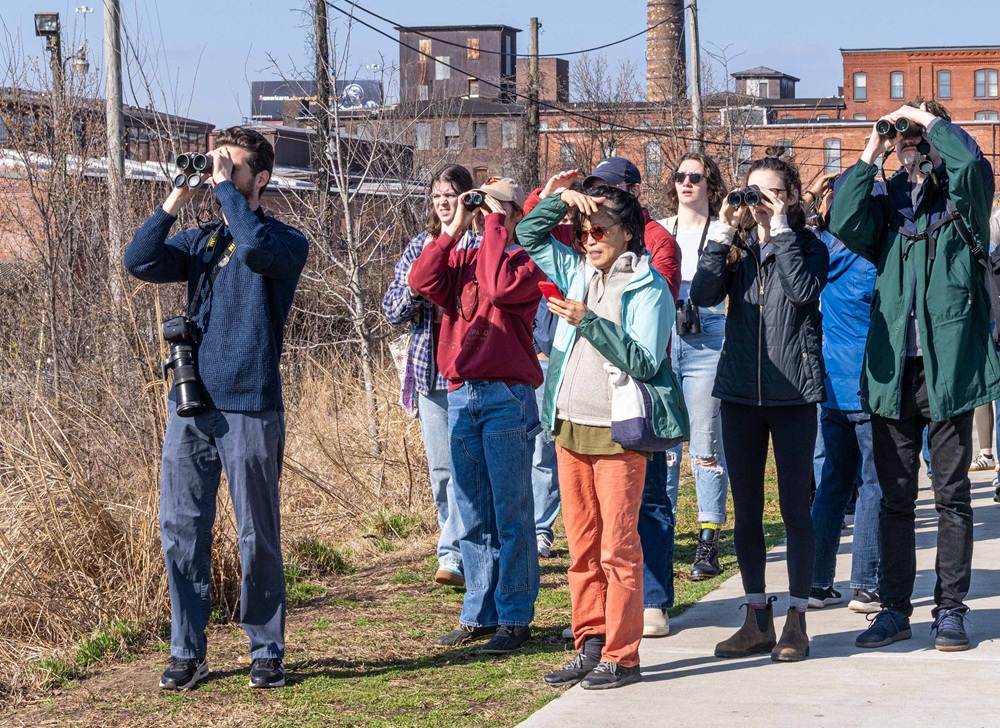
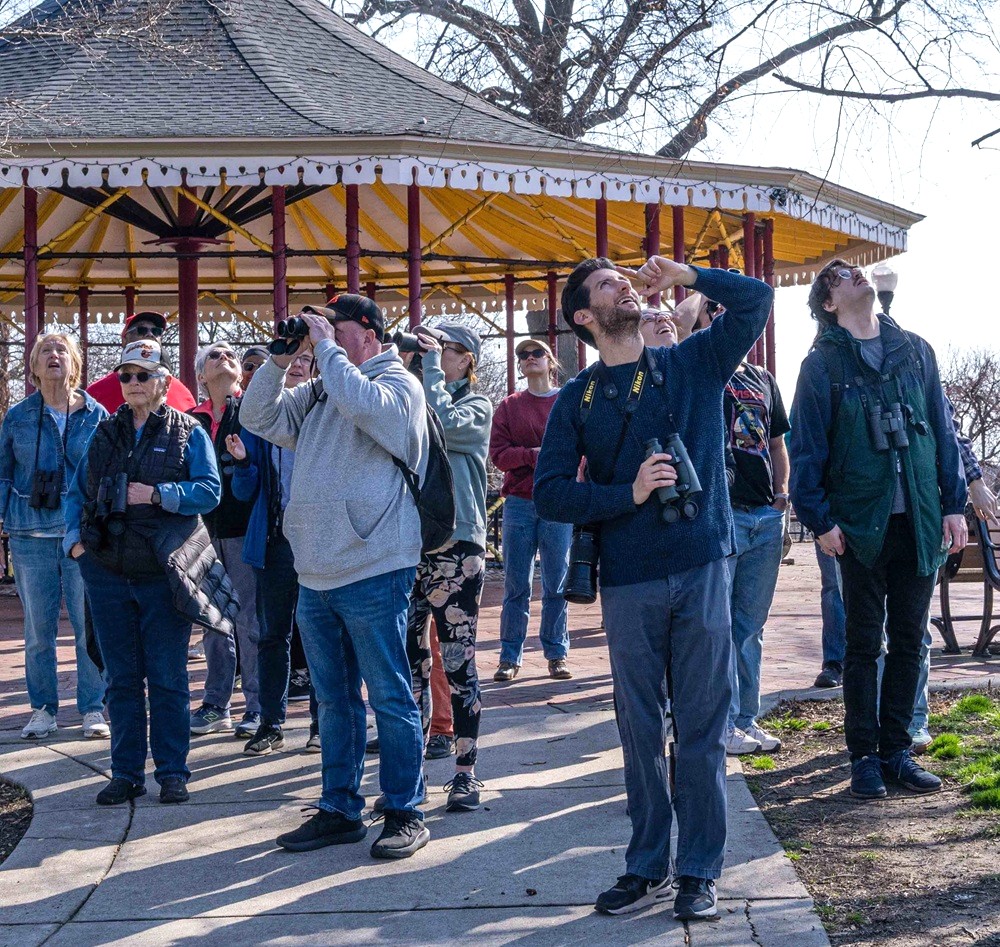
Baltimore Bird Club expert guides Charisma Burrows and Nico Sarbanes are leading a group of local birding enthusiasts on a bird-watching walk in Riverside Park on a crisp, sunny first day of spring, when they stop and gather by the pavilion to tally the morning’s sightings.
“We’ve had four or five Ring-billed Gulls fly over. Have we had any Cormorants flying over? I haven’t seen any,” says Sarbanes, checking his list. Suddenly, he looks up, then points and calls out, “There’s an Osprey with a fish!”
Binoculars and camera lenses rise to the sky in a flurry as the birders spot the incoming fowl and its prey. The Osprey glides directly overhead, wings spread wide, a large fish gripped in its talons.
“That’s special,” Sarbanes says as the group applauds. “That’s birding on the next level.”
Today’s walk is one of the many activities across South Baltimore recognizing the annual spring bird migration, which occurs from late February to mid-June and involves billions of birds returning to the U.S. and Canada from their winter homes in Latin America.
Sponsored by the Light Street Branch of the Enoch Pratt Free Library and the Baltimore Bird Club (a chapter of the Maryland Ornithological Society), the spring walk at Riverside gave about two dozen participants an opportunity to learn the basics of urban bird watching, including binocular skills, as the two guides offered tips for spotting different species over the course of a two-hour, two-mile walk.
“We’re still at the beginning of spring migration,” Sarbanes observes. “A lot of the migrants haven’t shown up yet. That will start in earnest the second or third week of April, but we have some starting to come through in late March. May is prime time.”
Sarbanes enthusiastically recounts his experiences birding in Riverside Park. “I’ve birded this park a lot over the last couple of years, and migration is super-productive here. One May morning I came before work, and one tree had seven Scarlet Tanagers. I don’t know if you’ve ever seen a Scarlet Tanager, but it’s a bird that gets a lot of people into birding because it’s so beautiful. That’s my high count for one tree anywhere in Baltimore. That’s just one example of why you should bird your neighborhood park.”
He continues, “Riverside Park is this great patch of green in the middle of a lot of development, so a lot of birds stop over here. If you live around the neighborhood and are familiar with the park, you know it becomes very popular with dog walkers at a certain hour, so you want to try to get to the birds before the people and the dogs come. If you get here early and you’re here on the right day, it’ll give you a sense of what’s possible here. You never know what could show up.”
Sarbanes wraps up his morning tally: “House Finch: we’ve had a few flyovers. No Goldfinch yet today. One Field Sparrow. Juncos: between 20 and 25. White-throated Sparrow, we’ve had a handful. Song Sparrow, we’ve had a handful. Red-winged Blackbird, we’ve had one flyover. We’ve just had one Grackle this morning, but we’ve had 15 before.”
He checks his list again. “We’re currently at about 25 species. Not bad.”
Saturday, March 21, afternoon…
“Eleven o’clock, off the starboard bow: Osprey with a fish!”
Binoculars and camera lenses suddenly flurry and shift their views as the excited voice calls out again: “It’s a big one!”
As roughly 40 boat-bound bird watchers gaze out across the sun-drenched waters of the Middle Branch of the Patapsco River, the Osprey, wings spread, swoops down from the sky to the river’s surface. Its long talons flash into the water and grab a big, squirming fish.
After a brief struggle, the Osprey pulls the fish from the river and lifts it into flight. Some Ring-billed Gulls circle and pursue the Osprey and its catch, and they all fly past our Water Taxi at close range to a round of cheers and applause from the bird watchers.
“Awesome!” “Incredible!” “What kind of fish is that?” The consensus is shad. This close-up display of nature in action is enough to make a birder’s day.
This afternoon excursion on the Patapsco is the latest iteration of the Baltimore Water Taxi Birding Cruise, a recurring event sponsored by Baltimore Birding, part of Delmarva Birding, a local organization of bird-watching enthusiasts.
Expert guides Russ Kovich, Brenda Miller, and Jim Rapp led the group of local birders on this trip around SoBo’s southern shores from Port Covington Marina over to West Covington Park, back out into the channel past Harbor Hospital, and on to Canton and Fells Point before returning to the Marina by way of Fort McHenry.
After starting the afternoon spotting a river otter next to the old piers behind the Sagamore Spirit distillery before the cruise launched, the enthusiastic birders ended up tallying more than two dozen species of birds. The list includes Bufflehead, Common Loon, Red-throated Loon, Double-crested Cormorant, Peregrine Falcon, Horned Grebe, Pied-billed Grebe, Red-necked Grebe, Red-winged Blackbird, Great Black-backed Gull, Ring-billed Gull, American Herring Gull, Fish Crow, American Black Duck, Mallard, Ruddy Duck, Osprey, and even a Bald Eagle.
And the great spring bird migration is just beginning.

