

(This article originally appeared in the June issue of the South Baltimore Peninsula Post community newspaper.)
Seventy-five years after the discovery of 19th-century caverns eroding the foundations of homes on the 600 block of E. Clement Street, the City of Baltimore has not released any details of its recent investigation into the current stability of the block initiated by complaints from a property owner two years ago (see Peninsula Post, December 2025).
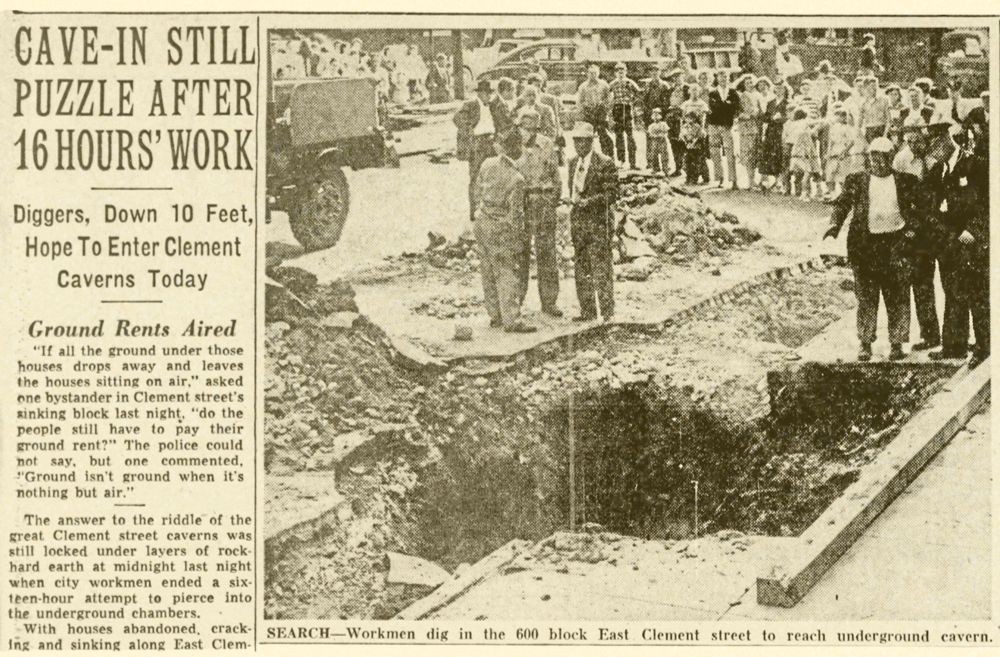
On Sunday, June 10, 1951, residents on the north side of the block reported that parts of their cellars had fallen away into blackness. The City closed the block and began excavating into the street, eventually discovering a series of long-forgotten, man-made caves about 30 feet below the surface. The City then filled the caverns, tore down six of the rowhouses on the block, took over the empty lots, and paved them over. The area remains undeveloped to this day.
The City’s current investigation was spurred by a 311 call in April 2024 from Nancy Waldhaus, whose rowhouse stands next to the empty lots, after she noticed damage to the foundation of her house. An investigation of the area with ground-penetrating radar by the Department of Public Works in 2024 was followed by a series of soil borings by a Department of Transportation (DOT) contractor in November and December 2025.
On March 6, the Peninsula Post requested a copy of the DOT contractor’s findings under the Maryland Public Information Act. That request was denied in an email from Hilary Ruley, chief solicitor of the City Department of Law.
On May 8, the Peninsula Post contacted DOT for a status update on its E. Clement Street investigation. A spokesperson for the department declined to comment on the situation.
In early May, WMAR-TV aired a news report on the Clement Street Caverns that included an interview with Nancy Waldhaus. The WMAR reporter also reached out to City officials for comment “but so far none have agreed to speak with us.”
In response to the original subsurface problem discovered on June 10, 1951, the City dispatched a crew of workmen that began excavating through the street on June 11. By mid-July, the network of caverns had been discovered and explored. Crews then began to refill the caverns and the shafts dug into the street. In October, Baltimore City Deputy Highways Engineer William Chilcote released a detailed report on the investigation. In November, demolition of the six condemned homes started. – Steve Cole

