

(This article originally appeared in the October 2025 issue of the South Baltimore Peninsula Post.)
By Catherine Harbour
A raven flying home from Fort McHenry to its nest in M&T Stadium might be distracted by solar panels glinting from the roofs of a few SoBo homes or from the larger arrays at the Maryland Science Center or the BGE Spring Garden complex. The curious raven might take a side trip over one of the community solar installations nearby in BGE’s service area that pump power into the electrical grid and lower their subscribers’ bills.
The Peninsula Post’s online poll this summer illuminated SoBohemia’s views on solar power. Of the 30 respondents, the majority (70%) don’t currently use solar power but are very interested in learning more about it, 10% subscribe to community solar, 10% use power generated by solar panels on their home, and 7% plan to have solar panels installed in the near future.
Household rooftop solar
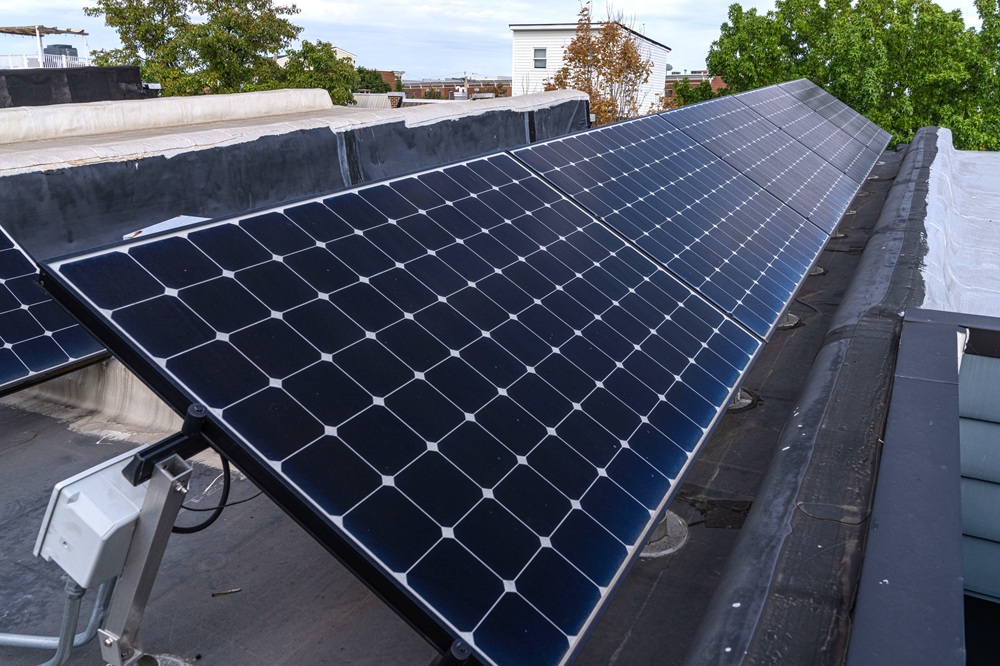
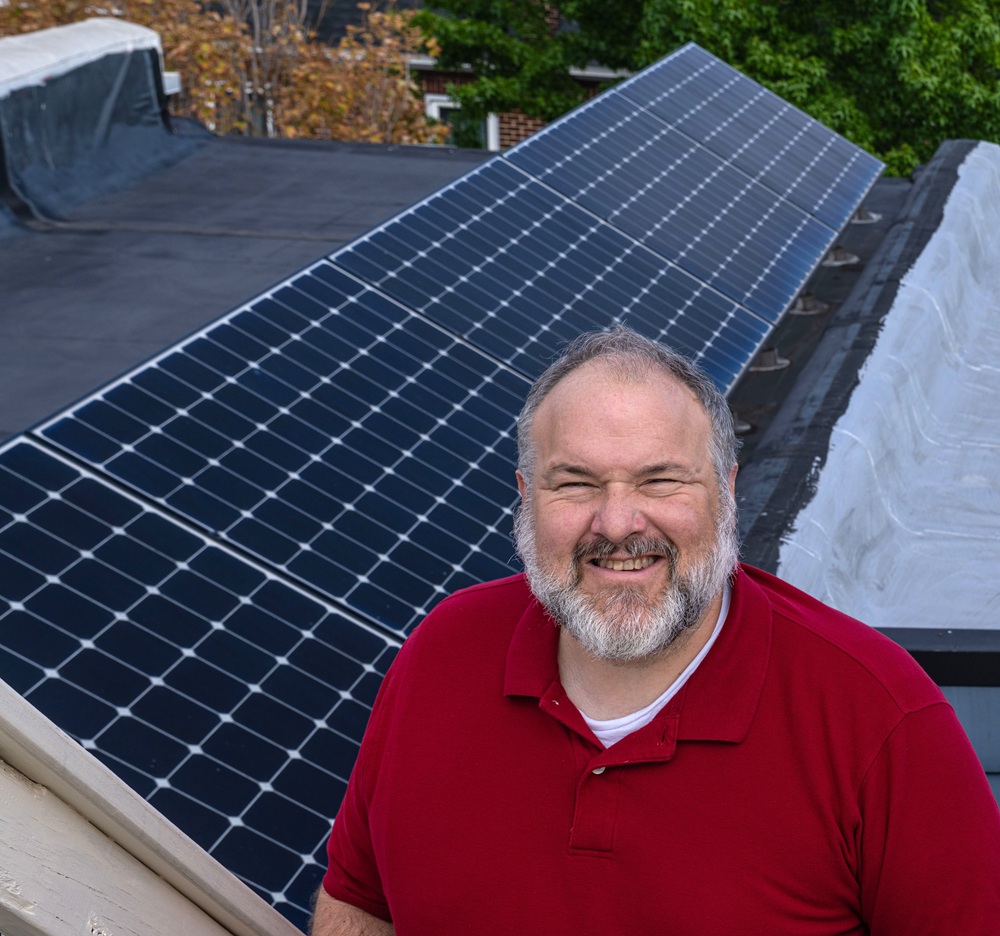
SoBo residents who have installed solar panels on their roofs share a strong concern for the environment. Saving money and the thrill of watching an electrical meter turn backward are also motivators. “I work in this industry,” says self-described “energy nerd” Chris Moore. “I had just replaced my roof, which is a gable roof that faces south with no obstructions, so I was a near-perfect candidate.”
Moore hired Lumina Solar to install panels on his Churchill Street home in 2020. The initial price was about $20,000, but a federal tax credit and state grant reduced the price to about $13,000. The 6.2-kilowatt (kW) system has 19 panels of 325 W each. Households that generate power from solar panels may also install a battery that stores power to use at night, during power outages, or when electricity rates are high. Moore’s system has no battery backup storage – “I don’t have the space for it.” Moore says he didn’t pay any electricity consumption charges to BGE in 2024. His 1,600-square-foot home with two adults was (just barely) a net producer of electricity in 2024.
Similarly, Ben Gilardi’s primary motivation was environmental. Cost savings were also a motivator. Two years ago, when Gilardi had 17 solar panels installed on his home near the West Street Garage, he already had experience with solar panels installed on a home in Hampden in 2007. Like Moore, Lumina Solar installed Gilardi’s panels, and he opted against installing a battery backup. Lumina surveyed the house, evaluated the roof, and managed permitting with Baltimore City. The original cost of Gilardi’s system was about $20,000, but about $7,000 came back in tax rebates and a grant.
“Today, I made 34.5 kilowatt-hours,” Gilardi tells me in our interview in late July. He estimates it will take about 11 years to recoup the costs, based on energy costs of three years ago. “My electric bill is $9.00 per month, every month,” he says. And, because his system sends surplus power to the grid, “BGE sends me a check every March.”
Locust Point resident Dave Arndt, an environmental and social justice advocate and former product and marketing director for BP Solar in Frederick, wanted to “walk the walk” of his advocacy work. Renewable Energy Corporation installed eleven 480-watt solar panels on Arndt’s Haubert Street house about four years ago, when state and federal incentives were still available. The payback period was 3-5 years.
Arndt points out that, “there’s a lot of R and D going on to get them to be more efficient. The price points are just fantastic from what they were in like 2008 to 2010 – half the price with more power – so the economies of scale have really been in our favor.” Arndt reports that his panels haven’t needed any repairs. In addition to rooftop solar, Arndt subscribes to community solar.
Moore, Gilardi, and Arndt use apps on their phones to track how much energy each rooftop panel is generating. “Today I produced 13.1 kilowatt-hours so far,” Arndt tells me when we speak on a July afternoon. When one panel produces less energy than its neighboring panels, the panel may be dirty or shaded. Rain or a hose can help remove the dirt. “I wouldn’t have to do this,” Arndt says, “but I want the peak output, so I go up there and spray them off and squeegee the dirt off.” Solar panels can last 30 years – much longer than a typical rowhouse roof. If you own a house, have a relatively new roof that gets enough sunlight, and you can manage the costs of solar panels and installation, you may be a good candidate for rooftop solar. When it’s time to replace the roof, the panels will need to be removed from the old roof and reinstalled.
Subscribing to community solar
Riverside resident and Maryland State Delegate Luke Clippinger knows his solar energy. He’s had solar panels on his own rowhome since 2017, and he led work on legislation that enabled community solar for many of Maryland’s utility service areas: a pilot program launched in 2015 that is now permanent. Both the Maryland/DC/Virginia Solar Energy Industries Association and the Coalition for Community Solar Access awarded him their Solar Champion awards for his efforts.
Community solar allows residents of BGE’s utility service area, both homeowners and renters, to subscribe to a community solar project within BGE’s service area and access solar-generated electricity without installing solar panels of their own. The program incentivizes growth in the market for renewable energy infrastructure in Maryland. Community solar projects are installed on roofs and plots of land that are much larger than a rowhouse roof but smaller than a utility-scale power plant.
“The reason that community solar is so important for me and the people of the 46th District is we have a lot of people who live in rowhouses, for whom big solar arrays are not practical,” says Clippinger. “I have a solar array on my house that generates about 4 megawatts a year. That’s okay for basically one person, but not for two, and certainly not for three or four.”
Legislation in Maryland requires that subscribing to community solar confers at least a 10% discount on a household’s electricity bill as compared to standard operating rates charged by the local utility. According to the BGE website, customers purchasing a subscription to a “community solar energy generating system” fund a portion of the energy produced and receive a credit on their BGE bill for their share of that solar energy.
As of this August, the Maryland Public Service Commission listed 93 community solar projects currently in operation within the BGE service area, with about 70 more under construction or in development. A community solar array and its subscribers need to be in the same service area so that the solar power generation, its users, and maintenance of the infrastructure are all managed within the same service area. Just under half of the BGE-area projects produce less than 1,000 kilowatts of electricity, and just over half produce between 1,000 and 2,000 kilowatts.
Ten organizations manage subscriptions for the in-service projects in BGE’s area, including Arcadia, Solar Landscape, Neighborhood Sun, Nautilus, and SunCentral. (Full disclosure: my household subscribes to Neighborhood Sun.) One array near the SoBo peninsula is Solar Landscape’s installation on the roof of a Public Storage warehouse in Cherry Hill. Some community solar projects offer special discounts for subscribers in low- and moderate-income households.
Community solar, says Clippinger, “opens the door to more people being able to generate solar electricity. It builds a larger market for people who want to get into solar electricity. And it allows for larger solar arrays, which are generally more efficient, to be built.”
With community solar, Clippinger points out, “You can be part of something that helps to chip away at your electricity costs, while at the same time, importing just a little bit less electricity from coal-fired power plants in the Midwest.”
While solar energy shines over all of SoBo, installing solar panels requires a sturdy roof and cash or financing for equipment and installation. The reward is the thrill of watching your electricity meter run backward, much lower energy bills, and the satisfaction of knowing your household has reduced its use of fossil fuels and hydroelectric power generation.
Subscribing to community solar confers many of the same benefits, without the up-front costs. “Everybody in South Baltimore should sign up for community solar,” says Arndt. “It is just really a no-brainer. You are going to save money on your electric bill. You are helping fund new solar panels. You are helping us get away from coal- and gas-fired plants for electric production. So you’re not only helping yourself financially, you’re helping the world.”

