

[This article originally appeared in the August 2026 issue of the South Baltimore Peninsula Post newspaper.]
By Robert Hardy
If you’ve ever been stung by a bee, visiting an apiary (a bee yard) can be slightly unnerving. Hundreds of bees are swarming around ramshackle boxes of hives. Hundreds more are flying in and out on regular swerving flight paths, out to forage for nectar then back to return their treasure to the hives to do what bees do best: make honey.
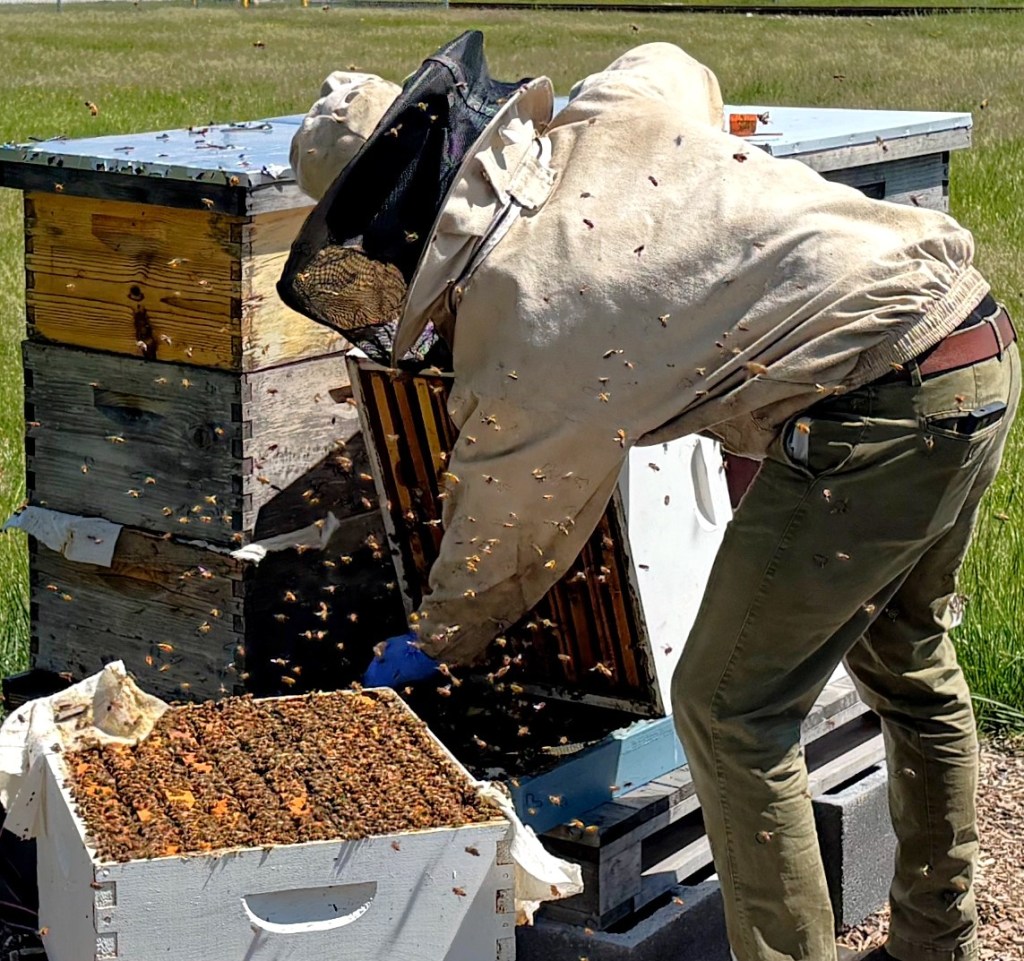
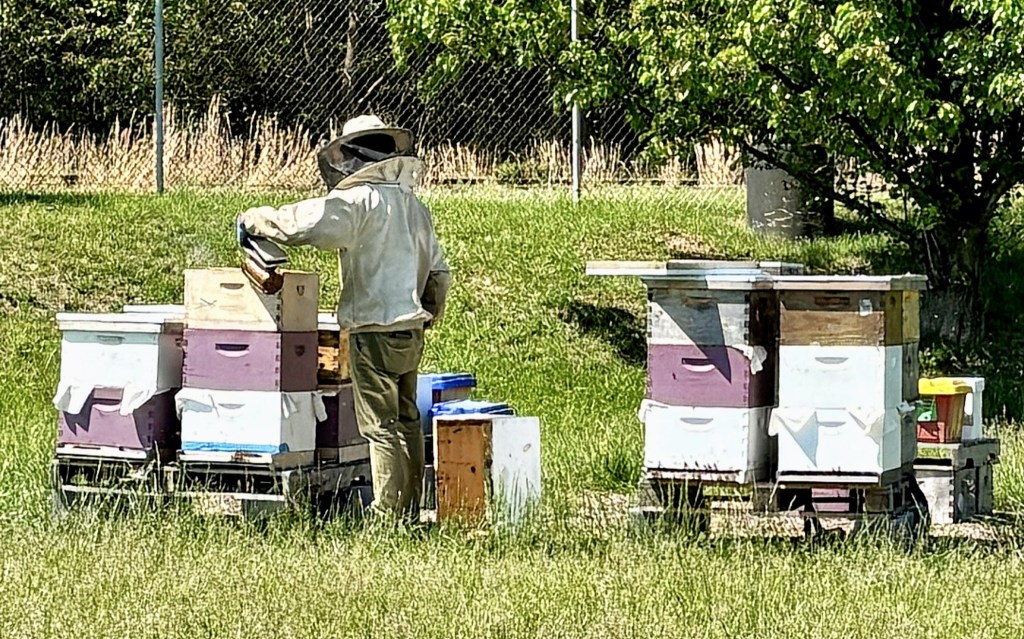
On a recent sunny spring morning in a grassy field on the northern edge of the Baltimore Peninsula development, Nikkia Rowe and her son Kairi Dukes of the John Newman Honeybee Company conduct a honeybee colony check in full beekeeping regalia: heavy jackets zipped tightly, thick trousers and boots, long gloves, and hoods with mesh veils.
“They’re peaceful,” Rowe notes as the bees fly around her. “They don’t bother you. They’re not ganging up. They are the presence now. They’re not aggressive. They get aggressive when there’s nothing blooming, and that’s when we usually go in to get honey.”
Rowe is the proprietor of the Baltimore-based company, which she founded with Dukes in 2019. Last year, they processed and sold about 1,600 pounds of honey, with sales primarily from their website and at local farmers markets. This year promises a similar yield.
“We put out our first batch of honey during the pandemic in 2020, and we’ve been going ever since,” Rowe says. “We have this collection of colonies here, and there’s another yard in the Avalon area, next to Patapsco State Park. We’re excited because the honey yield from this year will be the first yield from the Baltimore Peninsula.”
The John Newman Honeybee Company is named for Rowe’s maternal and paternal grandfathers. “Both of them were entrepreneurs and community-oriented people, so that’s why we honored the company by naming it after them,” Rowe says. Rowe grew up “right across Hanover Street Bridge in Cherry Hill,” she notes. “My grandparents, the Reeds, were one of the original families out there. They were community builders. They opened Reed’s Carryout in 1976, which was in operation until around 1984. And they loved community, just like we love community. And the bees love community.”
Rowe spent her career as an educator in the Baltimore City school system. “I was initially curious about bees because they appear to be chaotic,” she says. “I wanted to learn about bees in a transitional period in my life, so I went back to school and learned how to keep honeybees. I started with two colonies, and the first two years I couldn’t keep them alive. Every winter they would die. But I didn’t give up.
“When we started, we went to the community farm in Cherry Hill and they offered us a space, so that’s where we were for our first three years. From there, we went to the Black Butterfly Teaching Farm in Curtis Bay, and we were there for two years. Then we came here to the Peninsula.”
Dukes continues his colony check, pumping gentle puffs of smoke from his hand-held smoker as the bees do loop-de-loops around him. The smoke masks the bees’ “alarm” pheromones and makes them more docile.
“They’re going to pollinate just about anything that’s blooming,” Dukes says. “Now it’s black locust and horse chestnut, then magnolia, soon it’ll be clover, buttercups, dandelions, some honeysuckle. They go for [blooms with] the highest protein, the highest carbs.”
As Dukes opens the top of one of the boxes and carefully lifts out a frame crawling with bees, Rowe explains. “We’re in the time of year where colonies can get so large that they swarm,” she says. “So the queen will announce that it’s time for half of them to leave, and the workers will make queen cells. Then right before those queens emerge, half of the colony will leave. And we’re trying to prevent them from doing that. All beekeepers have to deal with that.”
Dukes holds each swarming frame aloft over the large wooden crates, carefully examining the bees, observing their behavior and their health, checking food stores, checking moisture levels, looking for signs of pests, scraping away debris, and checking on the status of the queens.
As Dukes works, Rowe educates some observers on what they are seeing. “All of these boxes contain full colonies,” she explains. “These smaller boxes are called nucleus colonies. In each one of them, we’re incubating five frames of bees and queens. At a certain point, they go into the larger boxes. This is the result of splitting them once, but they’ve already built their numbers back up.
“In each of those boxes are ten frames. On the innermost five or six frames, you have a brood: baby bees. The queen lays in a cyclical fashion, so around that circle of brood, you’re going to have patches of honey, which we never take, and patches of pollen, which we never take, because that’s how they feed the baby bees.
“Then in the last two frames on each end of the bottom box and in the second box, the frames are full of honey, front and back. We take those frames. As they move up higher, you see less and less brood and more and more honey. So the bees make their honey, they do their thing, and we come get it. We fight the bees to get it, and we extract it and jar it.”
“I only pull as much honey off the bees as we need to sell,” Dukes says. “I harvest the frames and remove them from the colony. Basically, I just shake all the bees off. Then I take the frames to a prep kitchen, cut off the wax capping that the bees applied, and place the frames into a centrifuge to spin the honey off. I do smaller harvests at whichever local kitchen is available, but for large harvests I use Greenmount Culinary Incubator on Greenmount Avenue. I trade the person who owns it honey in exchange for letting me process there.”
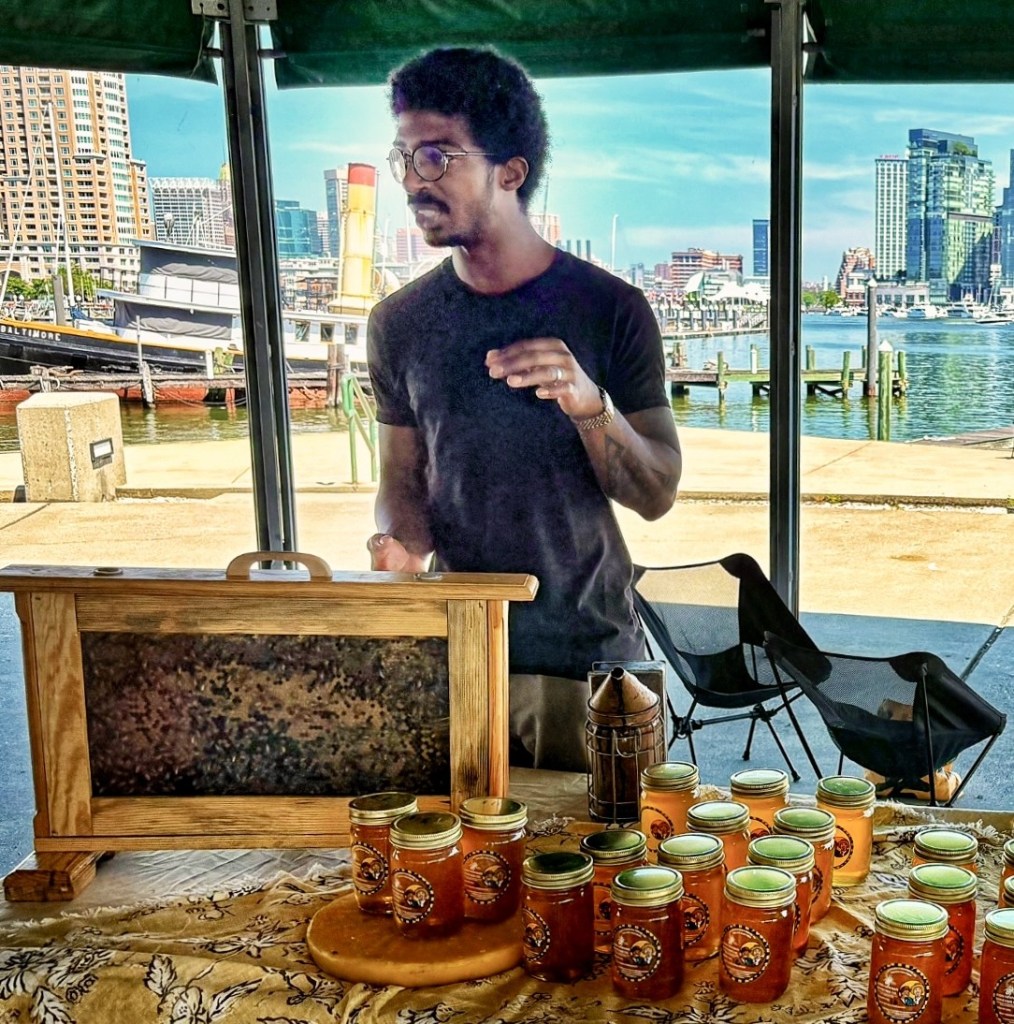
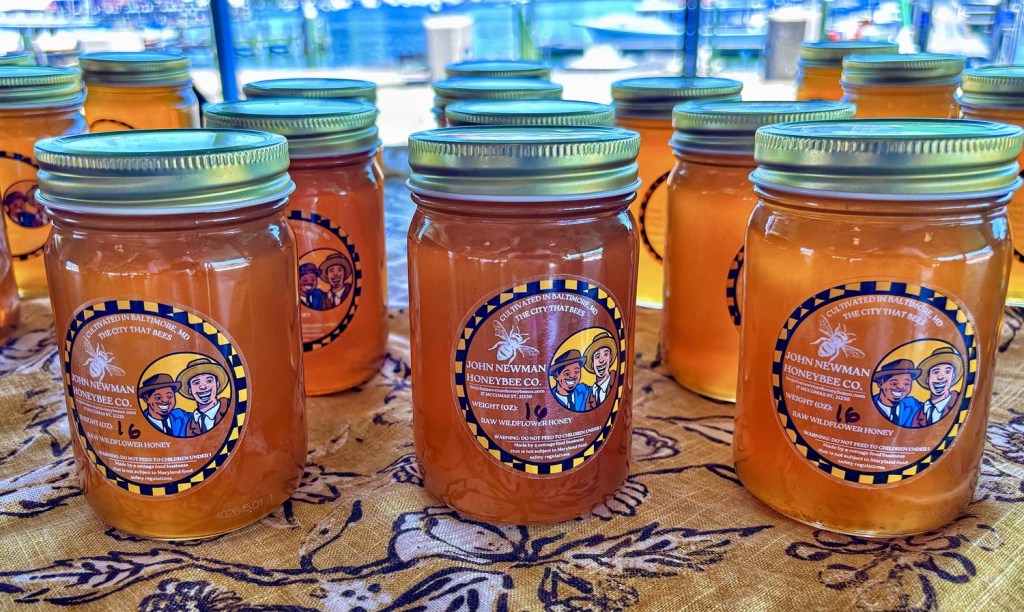
The fruits of the bees’ and the beekeepers’ labor are on display and for sale on a hot July morning at the Baltimore Museum of Industry’s Farmers’ Market on Key Highway: 16-ounce jars of rich, golden, raw wildflower honey, in a variety of flavors, dependent on the specific flowers from which the bees got the nectar.
“I get different varietals from the different colonies between our two yards,” Dukes explains. “So far, we’ve had black locust, linden, tulip poplar, bramble/blackberry/wineberry, clover, and princess tree (see the sidebar below).
As Dukes presides over the honey-laden market table, he describes his interest in the historical and ethical aspects of beekeeping, specifically of ancestral Black beekeeping. “Some Black people kept bees as a form of animal husbandry for their communities. Some did it to use the honey for religious purposes or because the actual trek to get the honey was a right of passage. Some did it to diversify their income because they were taught how to at Tuskegee [University]. Some were forced to do it because they had no rights or personhood. At the same time, some just had beehives on their property and would harvest honey. It’s one of those things you can find at any point in history.”
He also discusses the company’s apprenticeship program, “where we take on young Black people and teach them beekeeping” through field days and hands-on learning sessions. “We want to create opportunities for the community to come together and reconnect to these ancestral arts,” Rowe adds.
“We can learn so much from the bees,” notes Rowe. “With honeybees, nothing is about an individual bee, it’s always about the colony. It’s amazing. I think I could tend to bees the rest of my life and never learn every single thing about them.”
Learn more about the John Newman Honeybee Company and purchase their honey at their website.
SoBo Honey Varietals
Of the various characteristics that set one type of honey apart from another – flavor, color, viscosity, crystallization time, vitamin and enzyme content – the most basic determinant is the flower from which the bees harvested the nectar. Below, Kairi Dukes describes the flavor profiles of the types of honey that the John Newman Honeybee Company has harvested this year from their SoBo beehives. – R.H.
Black Locust honey is water-white, exceptionally light, and cleanly sweet with delicate, mild floral notes and a hint of vanilla, lacking any heavy aftertaste.
Linden (Basswood) honey tastes bright with a medium color and a distinct, refreshing bite that features a prominent minty, herbaceous, or slightly woody finish.
Tulip Poplar honey is dark, rich, and full-bodied, offering a heavy, robust sweetness with deep molasses and slightly malty undertones.
Bramble/Blackberry/Wineberry honey shows a medium-amber color with a well-rounded, classic honey flavor that delivers smooth, warm, fruity undertones and a soft berry sweetness that’s more forward this year. Because it’s been so dry, the bees are concentrating the flavors by lowering the water content.
Clover honey provides the quintessential honey taste: light, clean, and mildly sweet with a subtle, reliable floral aroma and a hint of warm cinnamon with a caramel undertone.
Princess Tree (Paulownia) honey comes across as very light and clear with a crisp, airy sweetness and faint, delicate fruity or pear-like notes.

