


(This article originally appeared in the August-September 2024 issue of the South Baltimore Peninsula Post.)
By Rachel Cohen
Pairs of eyes glance sideways, outward, and seemingly inward from the dozens of paintings hung floor to ceiling inside the artist studio of Lania D’Agostino on Light Street at the corner of Birckhead Street.
“I draw not what I think, but what I see,” D’Agostino said on a recent tour of the space where she has been creating since the mid-1990s. “I draw one mark on a piece of paper and then draw another mark; usually, the eyes first, and the rest of the figure comes out of it.”
The shapes sometimes take the form of “ancestors or spirits who come [into the painting] and want to be recognized,” she said, mentioning the adage, “The soul is in the eyes.”
From whimsically colorful to two-tone, D’Agostino’s paintings incorporate different media, from paint to embroidery with textural cross-hatchings and patterns. The figures are not female or male and are human-like but perhaps otherworldly in their fluid, clean shapes.
“Do spirits have gender?” she asked contemplatively. “I don’t know, is that a thing? I think it is just fluid.”
D’Agostino moved to Light Street about a decade after starting to work as an artist as a graduate of the Maryland Institute College of Art. She had spotted a for-sale sign on the then-boarded-up building while delivering art to School 33 Art Center across the street. She and fellow artist Jonathan Maxwell purchased the two-story building and adjacent rowhouse. Maxwell’s studio is on the first floor (see Peninsula Post, October 2023). Over the years, Maxwell and D’Agostino have each lived in the rowhouse at different times, making for a convenient commute.
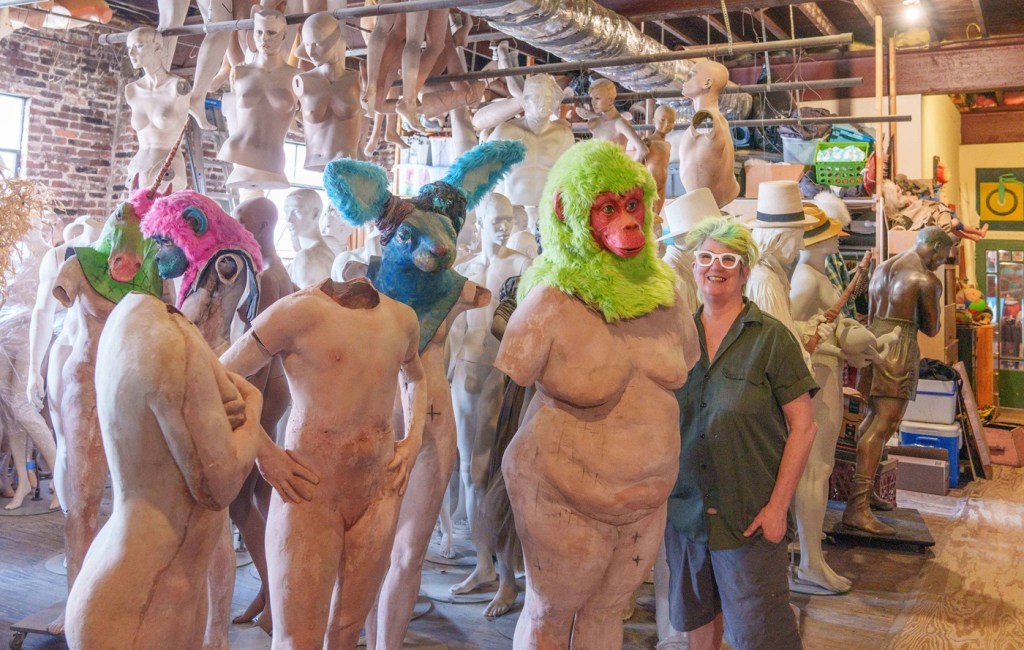
The corner was formerly the yard of a stone masonry shop and later a factory for Cummins Radiator Co., which is still operating locally. Beneath the high ceilings of D’Agostino’s main studio – the front corner room – are exposed brick walls housing large windows draped with dark curtains against the strong midday sun. At the other end of the floor is her D’Agostino Studios, LLC, where she sculpts and assembles life-sized castings of human figures.
Across one wall of her main studio are charcoal drawings on brown craft paper, from 30-inch-wide rolls. Once D’Agostino is generally satisfied with the outline, she glues the paper onto a wooden board and then fills in the images. She developed her process by illustrating directly on architectural drawings being used as drop cloths. Some of the features of those drawings would be incorporated into the final paintings, such as a gear wheel or the layers of paint drips from previous artworks becoming texture in a dress.
Comfy seating in the middle of the room faces sculptures of some of the figures from her paintings, which D’Agostino creates when she switches over to her sculptor side for a break from painting.
On display are some of the artist’s favorite portraits painted on tree-trunk cross sections with trees growing out of their heads. D’Agostino also creates on paper posted on the wall of a cabin in Pennsylvania that she owns with her partner, Heidi Yorkston, where she looks out to the woods, birds, and a creek. Trees sometimes appear in the background of her paintings, reinforcing the human connection to nature.

“Everything [in the winter woods] looks dead, but it’s actually the time of regrowth; the roots are growing into the mind and soul, so drawing on wood felt appropriate,” D’Agostino explained.
“It’s all about the energy in the room,” D’Agostino said, in talking about the time of day. “The evening is my spiritual time. The energy is calmer. It is different from the day, when the energy is more physical.” Evenings are when she can be found painting in her studio.
D’Agostino said she always knew she wanted to be an artist. Even when a high school counselor suggested she become a landscape designer, she knew she wanted to sculpt and paint. She recently completed a two-month show highlighting regeneration and renewal at Full Moon Acupuncture & Apothecary in Hampden with artist Jessy DeSantis.
Most of her paintings feel peaceful, but among the most dynamic is “Sisters of Kali,” named after an Indian change goddess of destruction. The painting shows three faces with their tongues out and D’Agostino’s characteristic large, wide eyes. “Sometimes I tuck them away because their energy is too much,” she said, adding that they usually stay behind the couch until she has a party and then the “Sisters” are brought out again.
When D’Agostino’s brother passed away while deer hunting, she began including antlers on the heads of many of her portraits. Now she feels comforted by her brother’s energy in them, she said.
Among D’Agostino’s most successful series of paintings are her portraits of jackrabbits, which were created at a point in her life when she was going through a lot of change. She visited Santa Fe, New Mexico, and joked about wanting to find a jackrabbit. In painting the rabbits, she found some to be doll-like and in need of repair while others were ready to bound forward and move ahead, embodying the spirit of a jackrabbit. She discovered that others looking at the paintings saw the same thing, that the paintings were like self-portraits of spiritual growth.
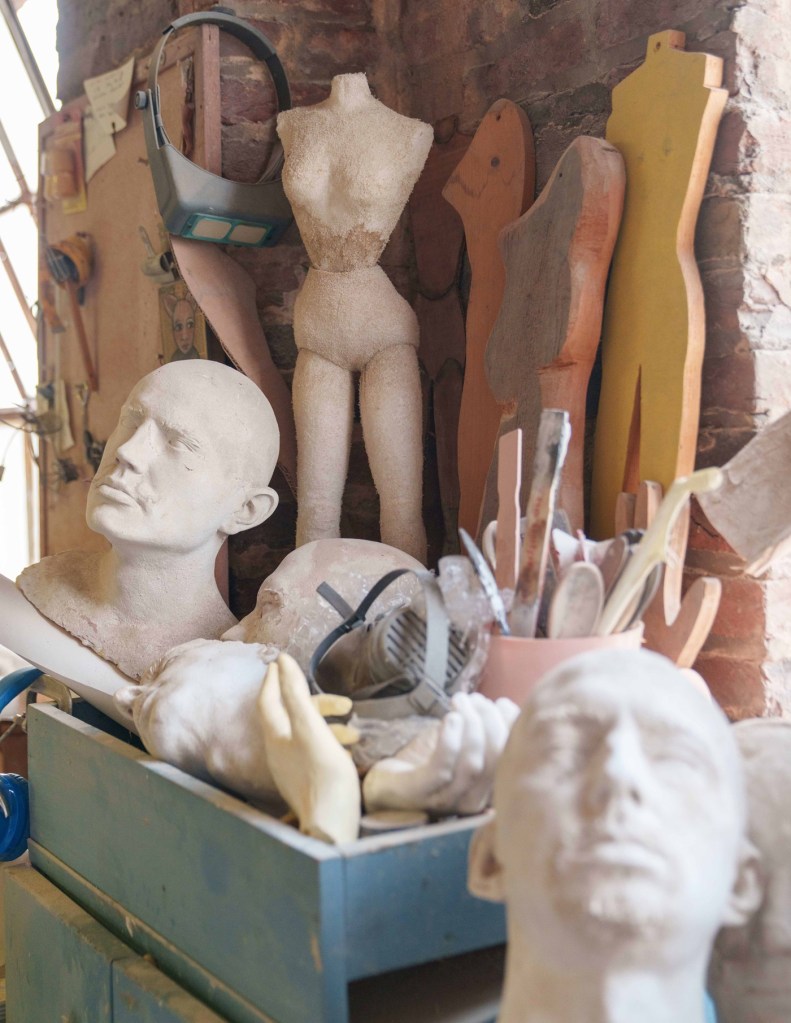
Daytime is when she works in the sculpting shop of D’Agostino Studios. The artist has created life-cast figures for the museum industry locally, throughout the United States, and for international destinations such as the Barbican in London and the Kyoto Museum in Japan. She has worked with the Smithsonian and Lucasfilms in designing and creating the figures for the Star Wars exhibits.
“The castings are not as much about the individual, but to tell stories within a museum,” she said. The figures are cast from a live model whose body shape and pose are eventually rendered in fiberglass. The models sign a release for D’Agostino to be able to reuse the molds. For example, she used one casting she made of a Microsoft CEO for a computer museum as the head of a farmer in overalls for a different exhibit.
Rows of spare mannequins and bins of spare body parts occupy the middle studio space. They can be reassembled and sculpted over to look more natural and realistic. Some are visible from the windows along Birckhead Street, a sight that her SoBo neighbors have enjoyed over the years.
For Pride Month in June, D’Agostino placed three life-sized figures exploring the gender transition process at the entrance of her studio. Representing the physical and spiritual form, a feminine Kristen transforms into a masculine Kris. The first figure is from the day before Kristen started taking testosterone. It’s a naked woman’s body with the arms covering the breasts. The second is one year later and the body has slimmed down. The third is three months after top surgery and the arms rest comfortably at the sides.
“I’m also excited by models who volunteer for projects and explore themes,” D’Agostino said. One of her favorites is a casting of her 30-year-old daughter when she was 12, dressed as a ballerina.
D’Agostino is coordinating with other Baltimore city artists to do an Open Studio Tour on October 5 and 6 from noon to 6pm. Her one-year goal is to present a full retrospective of her paintings, including some of her other art forms, with a performance. “We will have animal heads and costuming relating to my paintings,” she said.
To learn more about D’Agostino’s art, visit laniadagostino.com.
 South Baltimore Peninsula Post