

(This story originally appeared in the August-September 2023 issue of the South Baltimore Peninsula Post newspaper.)
It’s honey-harvesting day on E. Fort Avenue. More than a dozen neighbors and friends (including this reporter) descend on the rowhouse home of Mark and Stephanie Brick on a July afternoon to learn how to harvest honey and pitch in with the work.
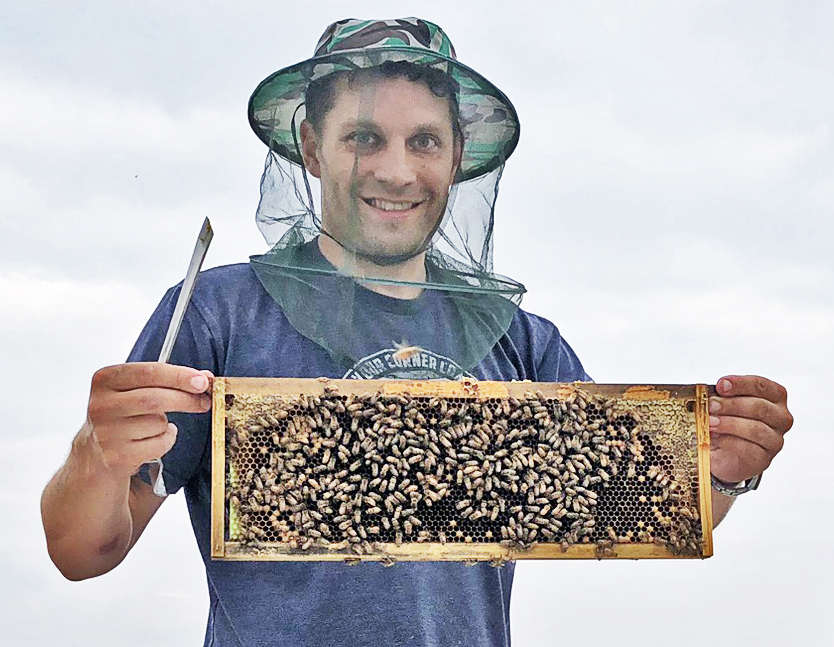
Several brave souls climb ladders up two stories from the backyard with Mark to the bare roof where he keeps his hives. They don protective bee hats and veils. Mark sends a few puffs of smoke from his handheld smoker into the hive to calm the bees before opening the hive to gingerly remove the honey-heavy frames, one by one.
Down below in the kitchen, others are dipping new Mason jars into boiling water at the stove, sanitizing them before they receive their 8 ounces of honey. Working with two honeycomb frames from a friend’s hive, Stephanie coaches helpers in the delicate art of removing the comb’s soft wax top layer to let the honey ooze out. A special, multipronged “uncapping fork” is the tool of choice.
Waiting for service on the kitchen’s large, center island countertop is a three-foot-tall, open-topped metal drum with a spigot near the bottom. Inside, two rectangular baskets attached to a crank protruding from the top stand ready to accept one unsealed honeycomb frame each. When cranked hard by hand, this centrifuge spins the frames fast, throwing their honey against the inside wall of the drum where it drips down to the bottom.

Last summer’s harvest at the Brick home near Light Street yielded just over 31 pounds of honey, most of it given away to friends and neighbors. Mark estimates today’s harvest will be a bit smaller than that, but more than enough to reward all the human worker bees helping with the harvest.
Mark is a newbie beekeeper, having started his first hive in 2020. He’s one of an estimated 100,000-plus hobbyist beekeepers in the United States and, he says, the only one with a rooftop hive on the South Baltimore peninsula. Not far away, hives are buzzing at the Filbert Street Garden in Curtis Bay and on the roof of the Baltimore Convention Center. (The hives at the Locust Point Community Garden were moved out of SoBo this spring.)
Mark’s first hive – three boxes stacked on top of each other – is the source of this year’s harvest. Several other single-box hives scattered over his roof are new and just getting established. He estimates that up to 80,000 bees annually call his rooftop home.
Mark decided to take up the beekeeping hobby after seeing a friend’s hive in West Virginia. He started buying materials to set up his own hives just before the pandemic, but it was taking an online beekeeping course offered by Penn State University in early 2020 that got the project moving. He’s now connected with other local beekeepers through the Filbert Street Garden Bee Club.

“Bees are a fascinating species. They’re a lot of fun to watch,” says Mark. “They do the vast majority of the work by themselves. You have to take care of them a little bit: watch for diseases, invaders in the hive, make sure the hive is the right size for them. I check on them once every week or two. But for the most part, you just let them go and they are going to work and be busy as bees and produce a lot of honey.”
Mark clearly identifies with the work ethic of bees. He runs three local small businesses, including a handyman service. “Bees are organized, and they work themselves hard. In the summer, bees actually work themselves to death. They live about six weeks, tops. But in winter, the bees that aren’t going out harvesting live about six months.”
Extremely busy periods for a beekeeper can pop up unexpectedly when a crowded hive “splits” and a large number of the inhabitants leave en masse to search for a new home. This creates an opportunity for the enterprising beekeeper to corral the home-hunting bees into an unoccupied hive and increase his or her honey-producing potential.
Mark’s original hive split four times this year. “When a hive splits, obviously the bees don’t tell you. I found out about one split in April at 8am on my way to a job,” Mark recalls. “I saw a giant clump of bees in a tree in front of our house. I had to call my client and say I’m going to be late.” He quickly gathered the bees into two hives before they could find other suitable accommodations themselves.
In May, with the help of another local beekeeper, Mark removed a rogue hive that had moved into a bedroom wall of a Locust Point rowhouse without the permission of the owners, likely after splitting from the hives in the nearby community garden. Mark offered the homeowners a reduced rate to use his services to get rid of the bees “in a friendly way” rather than hire an exterminator.
“Once we found out where the bees were in the wall, we sectioned off that part of the bedroom with plastic wrap,” Mark explains. “Then we cut the wall open and removed the comb from the hive piece by piece, attached each piece to frames with rubber bands, and then put the frames into a new hive box. We moved that box onto the roof of the house for 24 hours to let all the bees regather and follow the queen into the new hive. Then we moved the box over to my roof.”
The Locust Point “rescue” hive sits on the roof a few yards away from the three-box hive that Mark is working on harvesting day. With bees buzzing around him and bare-handed, he slowly lifts one frame at a time out of the hive, examining the honeycomb on both sides, looking for frames packed with honey. After a quick shake or two to convince the remaining bees to leave, he places the frame into a plastic bucket tied to a homemade pulley system that he’ll use to lower the frames to the ground.

Below, another member of the harvesting crew lifts one frame at a time out of the bucket, whisks off any remaining bees with a brush, and makes a beeline for the kitchen with the warm, honey-heavy frame.
Inside, the kitchen is now swarming with activity. One worker human sticks labels (“Brick’s Bees”) to the Mason jar lids. Another carefully wields the uncapping fork to open the honeycomb, wiping the wax into a glass bowl pooling with honey.
Two people grapple with the centrifuge: one spinning the crank at the top (8 minutes per batch), another holding it steady on the countertop so that the thread of honey dripping from the spigot lands squarely in the double strainer below. The plastic bucket beneath the strainers slowly fills will golden honey.
About three hours after the first foot hit the roof, the honey harvest is done. The messy but sweet result: 35.4 pounds of honey, Stephanie reports. The worker humans gather around the dining room table to relax, tend to a few minor stings, and admire the sea of “Brick’s Bees” honey jars.
“A lot of people say that city honey is better than country honey,” Mark says, “because in the city you have a better variety of plants for the bees to go to and there are far fewer pesticides than in the country. So you get this really great, pure honey in the city.”
The emptied frames, with most of their honeycomb intact, are returned to the hives on the roof. Mark expects that another honey harvest will be ready in late August. – Steve Cole

 South Baltimore Peninsula Post
This should not be allowed in the city. This is exactly how my rowhouse got burned down last year. An ember from the smoker lit the hive on fire and subsequently my neighbors roof top deck and then mine. Not to mention people can go into anaphylaxis from bee stings and this made my rooftop deck uninhabitable. I’m all for saving bees but it should be in areas that are safe for everyone.
LikeLike