

(This article originally appeared in the February 2025 issue of the South Baltimore Peninsula Post.)
By Robert Hardy
South Baltimore’s Cross Street Market is one of America’s oldest continuously operating public markets, opening in 1845. Four markets preceded it in Baltimore, three in the 1780s shortly after the city’s incorporation – Lexington Market, Broadway Market, and Hanover Market – followed by Hollins Market in 1836.
In 1838, residents of the growing South Baltimore area petitioned for their own local market. The city acquired land on E. Cross Street between S. Charles and Patapsco and by 1845 built an open-air wooden shed to house licensed vendors selling meat, poultry, seafood, fruits, and vegetables.
The market proved popular, and public support for expansion grew quickly. “There is considerable feeling in the southern section of the city in relation to the establishment of regular markets at the Cross Street market house,” according to an 1851 notice in the Baltimore Sun. “The folks over there have as good a right to have a market for their own convenience as any other people. … To be compelled to attend a market very distant from home is a very disagreeable thing.”
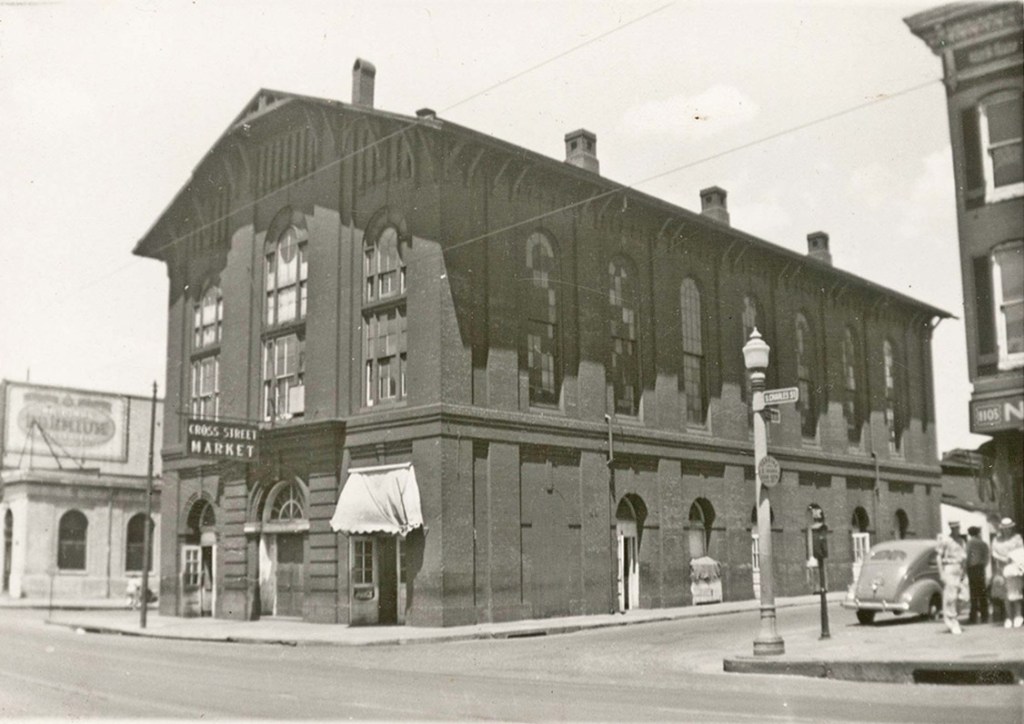
By 1860, the City Council passed ordinances expanding the market and commissioned local architect Frank Davis to execute the design. After closing briefly in 1869, Cross Street Market reopened in 1871 in a two-story Italian Revival-style brick building at E. Cross stretching from S. Charles to Patapsco with a single-story wooden shed continuing east to Light Street.
Modeled on Broadway Market in Fells Point, the first floor housed nearly 250 market stalls and the second floor featured a public auditorium and meeting rooms. By the 1920s, a basketball court on the second floor was used regularly by local leagues.
Although popular, municipal markets were rarely profitable for the city. The Comptroller wrote in a 1913 research journal article that “total license and rent charges upon the butchers of Baltimore markets were only $25 per stall per annum, and in many instances the city derived only $5 per stall per annum from street stalls.” The city provided light, water, cleaning, trash collection, repairs, improvements, and other services; the health commissioner had responsibility for sanitary conditions; and the department of weights and measures supervised market regulations around these activities, with city food inspectors “at all times in the markets.”
While the market’s high maintenance costs yielded low return for the city, consumers benefited. Fresh, high-quality food was a priority that kept competition at bay from small corner grocers. “[T]he housewife is compensated in going to the markets, not only in being able to purchase cheaper than from her groceryman, but particularly in being able to get first quality fresh goods,” Baltimore’s Comptroller noted in 1913. “Only the freshest goods are brought to the markets. In fact, some of the farmers and retailers sell their surplus after market hours to storekeepers in the city.”
Market inventory was extensive, and shoppers could usually acquire all they needed there. Fresh vegetables, fruits, meat, poultry, game, fish, oysters, crabs, canned goods, cakes, candies, butter, and eggs were all available in market stalls. Butchers often had the most profitable trades and occupied prime locations near the market’s entrances.


Catastrophe struck Cross Street Market early on the morning of Friday, May 19, 1951, when a 12-alarm fire destroyed the market buildings and a dozen nearby houses. At the height of the blaze, the Sun noted, “the center of Cross Street between Light and Charles was a seething pit of flame.” The fire started in the fish stalls and spread quickly, with nearby residents climbing onto their roofs to try to douse the sparks. The Sun reported that a butcher in the market said he had been fully stocked for Saturday trade and lost about $10,000, “and the fire was the second in two years to burn him out.” J.L. Harvey, operator of a butter-and-egg stall “for 69 of his 81 years without a vacation,” said after surveying the ruins of his stall: “Now I’ve got a vacation … and I don’t want it.”
This was the third city market to burn within two years: Belair Market burned just the previous week and Lexington Market two years prior.
The strength of the local relationship with Cross Street Market was evidenced in a Sun article after the fire: “South Baltimore housewives on their traditional Saturday shopping sprees today are walking through the charred remnants of the market building destroyed by fire last week and purchasing their needs from about 50 stalls which have sprung up in the street.”
Even as corner grocery stores and supermarket chains proliferated, the public market was still a primary provider of food. Cross Street Market reopened in its current structure in November 1952, with 20,000 people attending the opening. Operations continued for decades with stalls offering fresh market fare. For some years, the market had four butchers – including Fenwick Choice Meats (still operating in the market today) – and remained a center of community activity.
The ensuing years were not kind to public markets, and business declined as supermarket competition increased. In 2016, the city contracted with a private concern that undertook major renovations and brought in new businesses to Cross Street Market. The market that South Baltimore enjoys today is a very different type of market, although still part of the long history of public markets in America.
 South Baltimore Peninsula Post