

(This article originally appeared in the February 2025 issue of the South Baltimore Peninsula Post.)
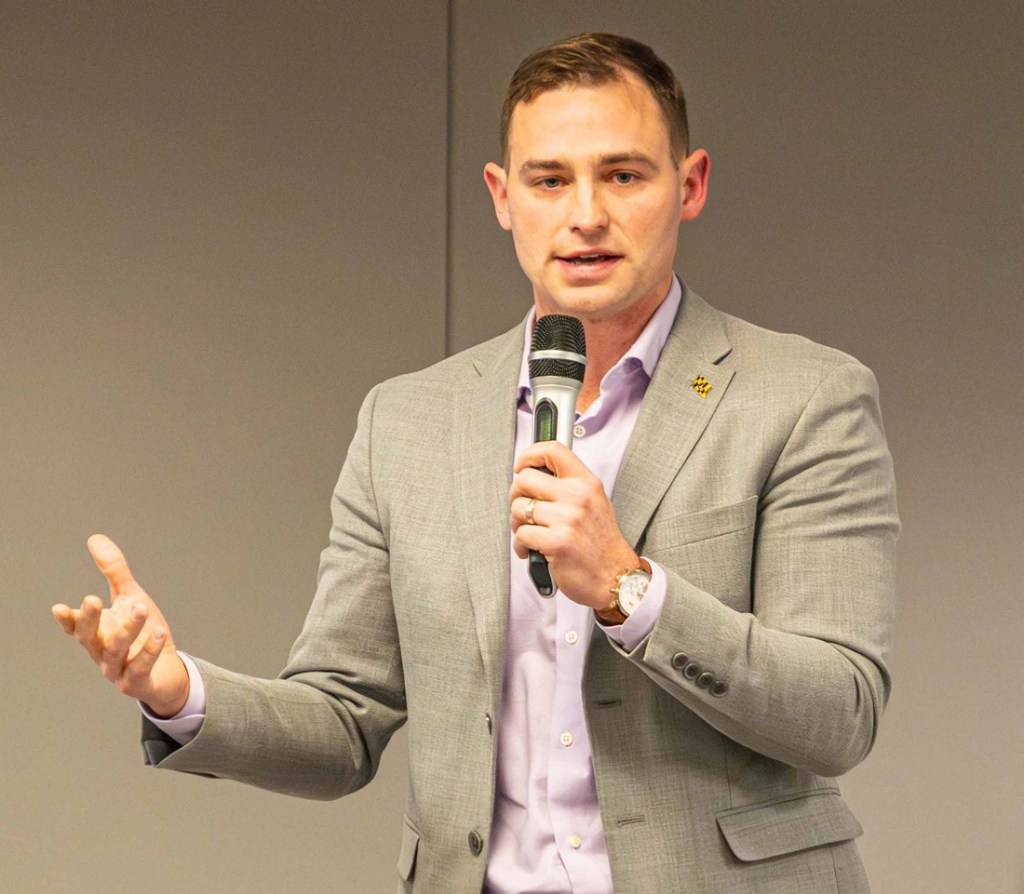
The peninsula’s new representative on the Baltimore City Council, Zac Blanchard, said in a January 21 interview with the Peninsula Post that he is ready to tackle District 11’s biggest issues. Blanchard was sworn in on December 5, replacing incumbent Eric Costello.
Blanchard, a Marine veteran, father of two, former President of the Federal Hill Neighborhood Association, and volunteer football coach at Digital Harbor High School, said he’s ready to hit the ground running. One of the big citywide issues he plans to focus on is the vacant housing crisis. According to Blanchard, there are around 400 vacant houses in District 11, which includes most of the SoBo peninsula as well as much of the downtown central business district and adjacent neighborhoods to the northwest.
“We have vacant homes because we’ve lost population, but we also are losing population because these neighborhoods have hundreds of vacant homes,” said Blanchard. “When a young person can see fifteen different boarded up doors and windows on their block, nothing says more clearly ‘there’s no future where you live’ than that.”
According to Blanchard, the city loses about $200 million each year because of vacant houses, and it’s an issue that ultimately impacts every neighborhood.
“When people ask ‘why are our property taxes so high and the services so bad?’ – this is a core part of the problem,” said Blanchard. “It may not be a problem in the neighborhood you live in, but it is a problem in the district you live in.”
Late last year, the City Council signed into law a bill to create a special property tax increase on vacant houses, but that’s not enough for Blanchard. By the end of this year, he expects the Council will pass a bill to also impose tax increases on owners of vacant lots.
Raising two young children in the Federal Hill neighborhood, Blanchard is particularly attuned to the quality of local schools. He is proud that District 11 boasts thriving primary schools with economically diverse student bodies, but he hopes to see the same success at Digital Harbor High School.
“Digital Harbor is the second largest high school in the city, and the percentage of students that come from lower income families is very high,” said Blanchard. “The percentage of students who come from families on the peninsula is very, very low. If we want to help all the students at Digital Harbor thrive, we have to make families on the peninsula feel good about their kids going to high school at Digital Harbor, so that’s a big item to tackle for me.”
Violent crime in the district is another important issue for Blanchard. Acknowledging that crime rates on the peninsula are significantly lower than the rest of the district, he believes that what happens in one neighborhood affects others and the entire city.
“Neighborhoods are connected to other neighborhoods. If we want neighborhoods that people feel good about staying in, raising families in, we have to solve the violent crime issue,” said Blanchard. “I’ve had good working conversations so far with the mayor’s office, the sheriff’s office, and the [Baltimore Police Department] Southern District. We will have a plan to make improvements by the spring. I can’t guarantee that it will work, but I can guarantee that we are very serious about making actual changes for our residents. We want to make people feel safe.”
For Blanchard, small, local issues matter too. Blanchard says he already has legislation in the works to improve District 11’s Main Street programs (including Federal Hill’s on the peninsula), while also working on road and pedestrian improvement projects.
One of his goals is to work on making public spaces in the district more vibrant and efficient. An area on the peninsula that Blanchard would like to see improved is Key Highway. He says it is not particularly pedestrian- or cyclist-friendly, and he’d like to see changes made including bike lanes, traffic calming, and road revisions.
“Key Highway is right next to the harbor. We’re splitting off our neighborhoods from one of the most important assets our neighborhood has,” said Blanchard.
He also aims to make the city’s free Harbor Connector water transit system a seven-day-a-week service.
“We have to support all of our neighborhoods, and we have to grow our population. If we don’t do these things, the city is going to be in the same situation it’s been in,” said Blanchard.
Blanchard hopes to hear from residents about their concerns and issues. He encourages citizens to reach out directly to his office via email at zachary.blanchard@baltimorecity.gov or by phone at 410-396-4816. – Saskia Lindsay
 South Baltimore Peninsula Post