

(This story originally appeared in the October 2024 issue of the South Baltimore Peninsula Post.)
By Robert Hardy
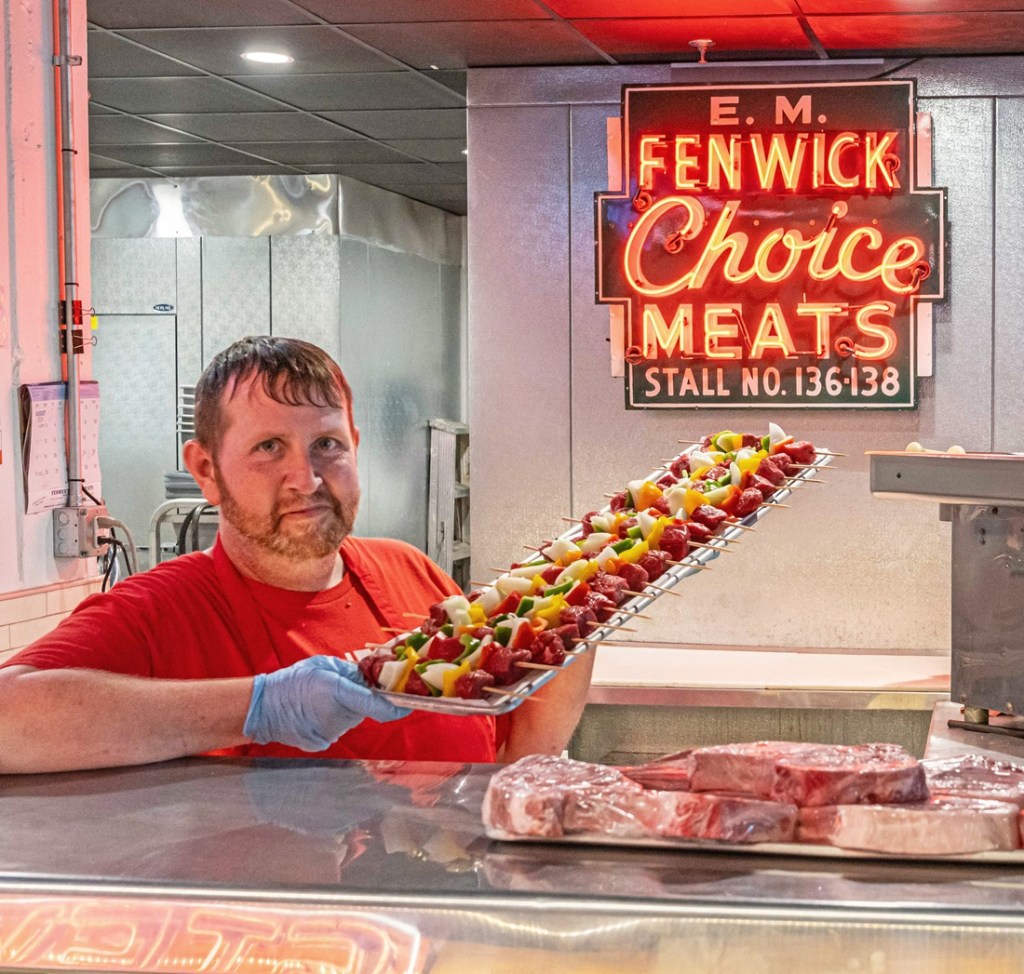
When Manuel Raymundo stands behind the meat counter at Cross Street Market, carefully feeding seasoned ground pork into a gleaming steel sausage-stuffing machine, methodically filling balloon-like natural sausage casings and tying them off one by one, he’s making a product that has been made at Fenwick Choice Meats for more than half a century.
“Our sausages have always been popular with customers,” he says, holding up a handful of plump, pink links, “because they are a good, quality product. And that’s number one: a quality product.”
Offering high-quality products at fair prices is at the top of a long list of standards, maxims, and lessons that Raymundo, 47, learned from his mentor and predecessor at Fenwick’s, Henry Reisinger. At the beginning of 2024, Raymundo took over ownership of the shop from Reisinger, who retired from the business after more than 50 years. Reisinger bought the business in 1987 from Mrs. Edith Fenwick, who had owned the shop with her husband since the 1950s. The business occupied one of the first stalls in the Market when it opened in 1952 after a massive fire destroyed the original building.
“Henry was working for Miss Edith after school and before school, then eventually full time,” Raymundo says. “He grew up with my mother, so he’s known me since I was in my mother’s belly, that’s how far back we go. He taught me everything I know about the meat business and about business in general: how to keep things in balance and not overspend, fair pricing, the importance of customer relations, cleanliness, just everything.”
Raymundo became involved with Fenwick’s through his relationship with Reisinger, who offered encouragement and a chance to help out around the shop. “I’d walk through the Market every day on my way to and from school,” he recalled, having grown up on Olive Street in South Baltimore. “I’d see Henry waiting on customers or cutting meat, and we’d talk, and I was always fascinated. Then, years later, I left my job at the Post Office, and I was still interested in the business. I always liked to cook, and I love good food.
“One Saturday, he brought me in and started me off with first things first, the proper methods and techniques, the proper tools, and always, ‘wash your hands, wash your hands, wash your hands.’ He drilled that in. One day, during a six-hour shift, I counted the times I washed my hands: 152 times. I shadowed Henry for some time, until he said, ‘take the knife and do it for yourself.’ And I did. I worked with Henry full time for 13 years.”
As a customer comes to the counter one afternoon this summer, Raymundo looks up from a rack of pork chops he’s cutting and greets her, then sets his knife down on the cutting table, and goes to the sink to wash his hands. She wants a pound of Virginia ham sliced thin. Raymundo takes a ham from the display case to the slicing machine and smoothly, expertly works it back and forth, the paper-thin slices falling neatly onto a sheet of butcher paper. When Raymundo suggests a cheese that would go nicely with the ham, the customer thinks that sounds good, and she leaves with both ham and cheese.
“Listening to the customer, making suggestions, helping the customer out. I think that’s why our customers return,” Raymundo tells me as he washes his hands again after the transaction. Raymundo estimates he spends about half of his day interacting with customers and serving them at the counter and the other half “being productive” and manufacturing the homemade products for which Fenwick’s is known.
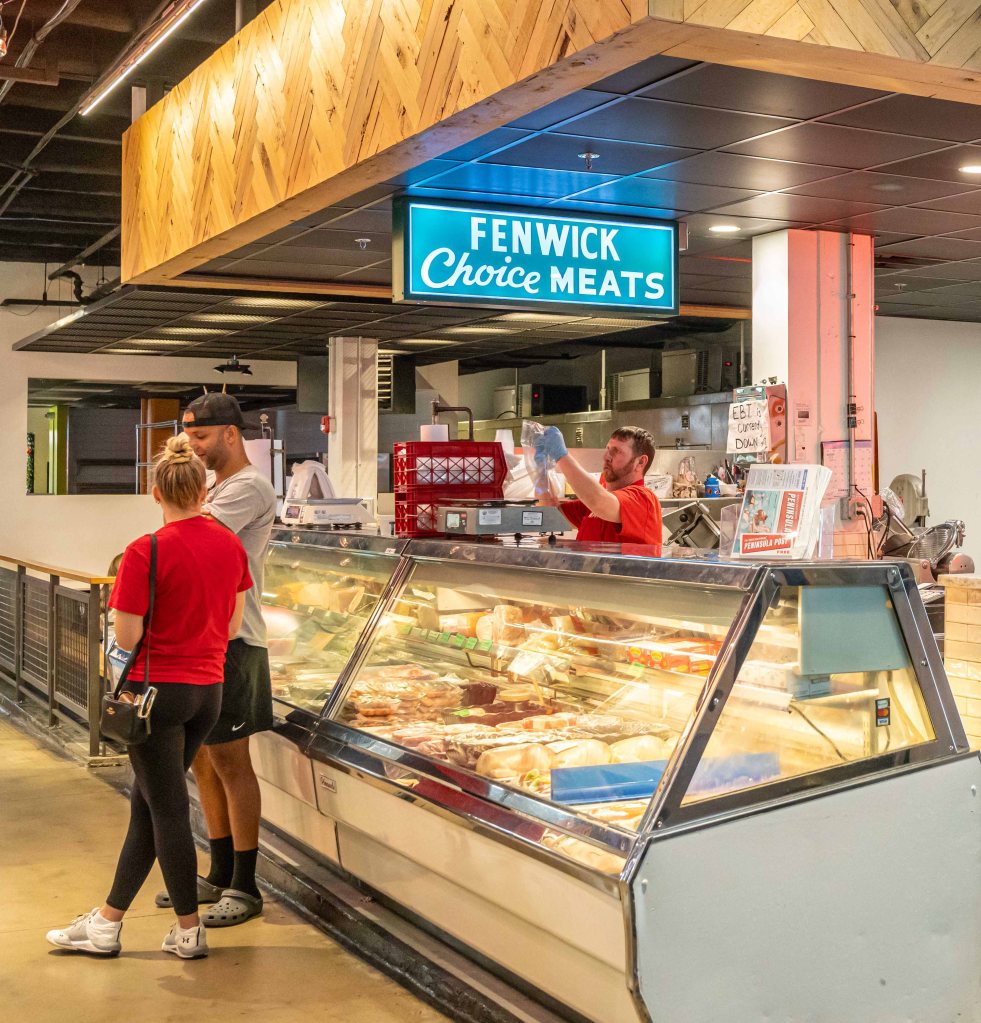
Besides their pork sausages, Fenwick’s makes chicken sausages (from boneless, skinless, chicken breasts and thighs; garlic; sun-dried tomato; and herbs and seasonings) and veal sausages. “We also make an authentic German pork bratwurst, which is very good,” says Raymundo.
“And then there’s the crab cakes.” He estimates that the shop sells around 45 to 50 crab cakes a week. “It’s probably the most popular homemade product we do. We don’t mix with a spoon. We mix with our hands to preserve the lumps, because the spoon breaks up the lumps. Everybody loves to see those big lumps of crab meat.”
I have to ask: What’s the secret?
“Honestly, keeping filler to an absolute minimum. We use Old Bay crab cake seasoning mix, so with the little bit of filler that’s in there, we add nothing extra, just good Hellman’s mayonnaise, and that wonderful jumbo lump crab meat. And that is it. That is the winner.”
Reflecting on some of the changes he’s seen in the business, in the Market itself, and in the surrounding community, Raymundo notes some of the ways that Fenwick’s has been able to adapt and adjust.
“Over the last decade or so, there’s been a big movement toward preprepared foods for people who work long days and don’t want to prep a full meal and cook it with all the pots and pans and dishes and stuff,” he says. “I try to do things to help them out. I do as much prep as I can for things that require a little prep. For example, we do a wonderful stuffed pork chop: cornbread stuffing on three-quarters of a 1.75-pound boneless pork chop. People love that. You just take it home and put it in the oven and 25 minutes later, your meal is done.”
Consistently popular meats also include whole chickens, thick-cut pork chops, New York strips, and rib eyes. An impressive standout in the meat case is the “tomahawk” steak: a massive 2.5- to 3-pound beef rib eye steak prepared in the shop that is currently among the most popular cuts at Fenwick’s. Raymundo describes the process of creating the tomahawk cut:
“From the kill floor at Old Line Meats on Monroe Street in Baltimore, they’ll send me a half a rib portion: half of the steer’s rib, around 65 or 70 pounds of all rib meat. That’s where you get your bone-in prime ribs, your boneless prime ribs, your short ribs, and of course good ground beef off the trimmings of all that rib meat. I cut down each individual rib, usually 2.5 to 3 inches down each rib, with the knife. Then I carry this 55- or 60-pound rib portion over to the saw and just cut the bone. The meat is cut with our knife, not a saw blade. It’s just a much cleaner cut, a better cut, honestly.”
Raymundo shows off the resulting cut after the steak is French trimmed, leaving about 5 inches of bone artfully exposed like the handle of a tomahawk. “It looks good, and it tastes even better,” he says proudly. “Grill these up, and then bake them with butter and herbs. Absolutely delicious.”
As a couple of customers approach the counter and begin perusing the choices, Raymundo looks up and greets them. Before he turns to wait on them, he steps to the sink and washes his hands.
 South Baltimore Peninsula Post