


(This article originally appeared in the August-September 2024 issue of the South Baltimore Peninsula Post.)
By Mark Hannon
Shipping and oceangoing travel have been part of SoBo life dating back nearly two centuries to the arrival of the B&O Railroad on the peninsula’s northern shores. From the waves of European immigrants who first set foot on American soil in Locust Point to the tons of grain, sugar, and other raw and manufactured goods coming and going, peninsula piers and docks have provided jobs for generations of Baltimoreans.
Today, the Port of Baltimore is the sixth busiest port on the U.S. Atlantic and Gulf coasts. Although much of that activity is now concentrated east and south of the peninsula, along the Patapsco River at the deep-water docks of Dundalk and Seagirt, working docks still occupy a large swath of the Locust Point shoreline.
Earlier this year the Peninsula Post visited several of these terminals and talked with longshoremen and importers to give readers an introduction to the working life of the docks of Locust Point.
That work involves an array of specialized skills and responsibilities, each one carefully choreographed to move products (or passengers) safely and efficiently on or off ships at the different private and public terminals along the north and south side of Locust Point.
A Variety of Jobs
The first essential step is getting an incoming ship safely docked. As a ship approaches the Port of Baltimore, it is boarded by a docking pilot, a captain belonging to the Maryland Pilots Association, who has intimate knowledge of the channels, berths, tides, and weather conditions of the port. The docking pilot directs the helmsman and the supporting tugboats to get the vessel safely against the pier, where the ship’s deckhands will send down to the dock lightweight heaving lines attached to the heavier mooring lines. These mooring lines are then attached to bollards on the pier by line handlers hired by the terminal’s operator.
The Port of Baltimore is one of the busiest ports on the U.S. Atlantic and Gulf coasts. Although much of that activity is concentrated east and south of the SoBo peninsula, working docks still occupy a large swath of our shoreline.
Now, the longshoremen go to work. At the public terminals in Locust Point operated by the state’s Maryland Port Administration, these are union workers, members of the International Longshoremen’s Association (ILA). The shipper begins the process by contacting a stevedoring company; Canton Stevedoring is the principal firm at the North Locust Point Terminal. The company then contacts the local union halls for whatever labor is required, and ILA members available for work are assigned to specific tasks for that ship.
Three local ILA unions handle three different types of work involved in unloading and loading ships. Local 333 represents the “longshoremen” who load and unload ships and barges with cranes and forklifts and secure the cargo.
Local 953 represents the “checkers” who have a variety of roles, including steamship clerks, weighers, billing clerks, and timekeepers. Checkers admit the trucks and trains to the dock, checking and recording their cargos, assigning them positions for storage, and scheduling them for loading or unloading. Others “work the ship” by going over loading and unloading plans and making sure containers are loaded or unloaded in the right order and stowed in the right locations. If done incorrectly, valuable time – and time is money in the shipping business – is lost searching for a misplaced container and getting it back in the queue.

Local 1429 represents maintenance workers. According to Michael Pirisino, president of the Maryland Line Handling Company, their duties include maintaining and repairing shipping containers, securing specialized “project” cargo on railcars, and cleaning storage sheds after cargo has shipped. They are also responsible for tying and untying the ships at their berths.
In Baltimore, being a longshoreman can be a multigenerational occupation. Some families can claim four generations on the waterfront, going back to the days when a strong back and the ability to swing a cargo hook were all that were required, despite the dangerous work environment. In those days, many workers lived within walking distance of the docks, most often from East Baltimore, South Baltimore, and Locust Point.
The Vogel family represents this tradition in Locust Point, contributing four generations of longshoremen. According to Eddie Vogel, his father, Edward Vogel, Sr., started on the waterfront in the 1940s and worked there until 1976. Eddie joined him right out of high school in 1968, and except for two years in the U.S. Army, he worked for 43 years on the docks. He started as part of a “gang,” a crew of longshoremen who manually moved cargo, then became a “driver” (moving cargo with forklifts). Eddie’s son Jeff is a “lasher” (a longshoreman who secures cargo), and his grandson Gabe is a checker, both ILA members.
This port workforce is kept busy year-round handling goods and services that arrive and depart from the peninsula. Some may be familiar to you; others will surprise you. Here’s a sampling.
Metals for Manufacturing
Just outside the gates of Fort McHenry, the C. Steinweg (Baltimore), Inc., a subsidiary of a Netherlands-based company, has a privately owned cargo terminal which handles “break bulk” (noncontainerized) cargo from all over the world, says facility manager Marc Kiriou. A great deal of the commodities handled here are metals such as aluminum, nickel, lead, and zinc.
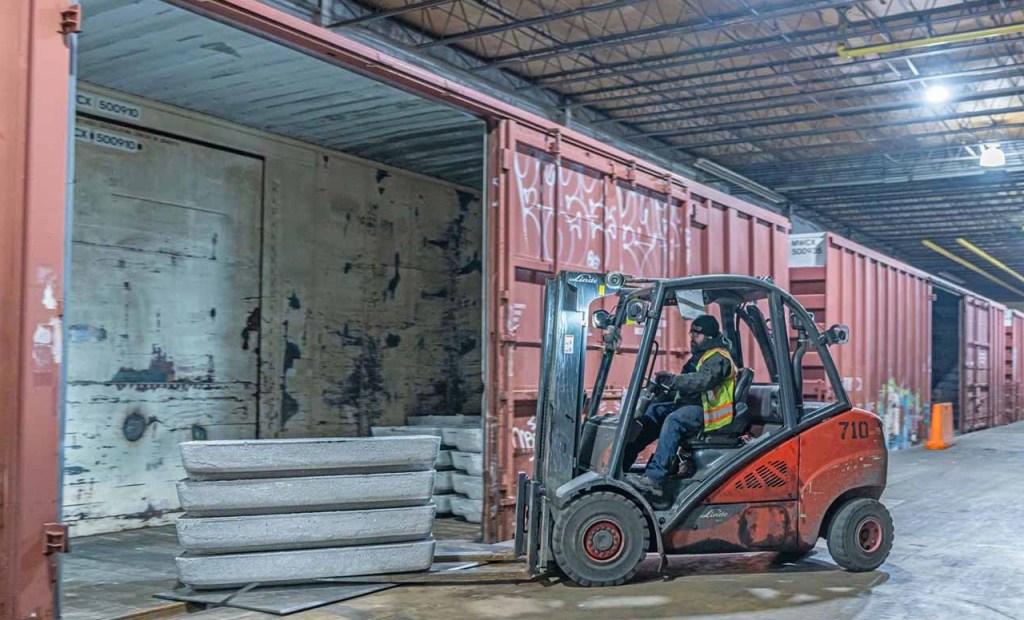
Storage facilities on both sides of Fort Avenue include warehouses for sensitive materials and open-air storage for ingots of aluminum. The cargos are unloaded by the ships’ own cranes at their south side berth or by Steinweg’s two 180-foot tall, 35-ton electrically operated cranes at North Locust Point Pier 1. The cargo is stowed in extensive storage facilities before being shipped out by rail or truck.
The metals brought in by Steinweg serve many purposes. Aluminum is generally used in manufacturing automobiles. Lead and nickel are used to make batteries and other finished products. Zinc is most often used for galvanizing iron and steel products to deter rusting.
Feed for Livestock
At the foot of Hull Street, by the water taxi stop, you can’t miss the giant storage tanks painted with the images of Baltimore sports legends Ray Lewis, Cal Ripken, and Michael Phelps. You may also get a whiff of molasses from one of the approximately 30 steel tanks on the grounds of the Westway Feed Products facility. One of the tanks holds up to 3 million gallons of molasses.
The molasses that Westway processes into livestock feed comes from nearby Domino Sugar (molasses is a by-product of sugar refining) and on ships from Mexico, Belize, Guatemala, El Salvador, Honduras, and Nicaragua. It is mixed with various additives including vitamins and minerals to make animal feeds, stored, and trucked across the Mid-Atlantic. When the Peninsula Post visited, trucks were loading feed for a dairy farm of some 3,500 cows near Harrisonburg, Va. Westway employs two shifts: the first starts at 1am, the second finishes at around 3pm, so the 15-20 trucks a day they service can avoid the heaviest traffic.
Westway is getting ready to open a new production building or “mix house,” according to plant manager Matt Belstra. This building is where the proportions of molasses to additives are adjusted. They also plan to replace some of the older storage tanks. When the mix house and new tanks come online, the facility’s speed of production will double, Belstra said.
Westway shares the steel finger pier where the liquid bulk ships dock with BWC Terminals, which moves such items as liquid specialty chemicals, caustic soda, fertilizer, petroleum products, base oils, biodiesel, wax, and olive and vegetable oil. These products leave Locust Point by rail and truck.
Raw Sugar
The Domino Sugar plant on Key Highway has been refining sugar at the foot of Woodall Street for over 100 years. The refinery can produce more than 6 million pounds of sugar a day and employs over 500 people who work around the clock in three shifts, says Peter O’Malley, vice president for corporate relations.
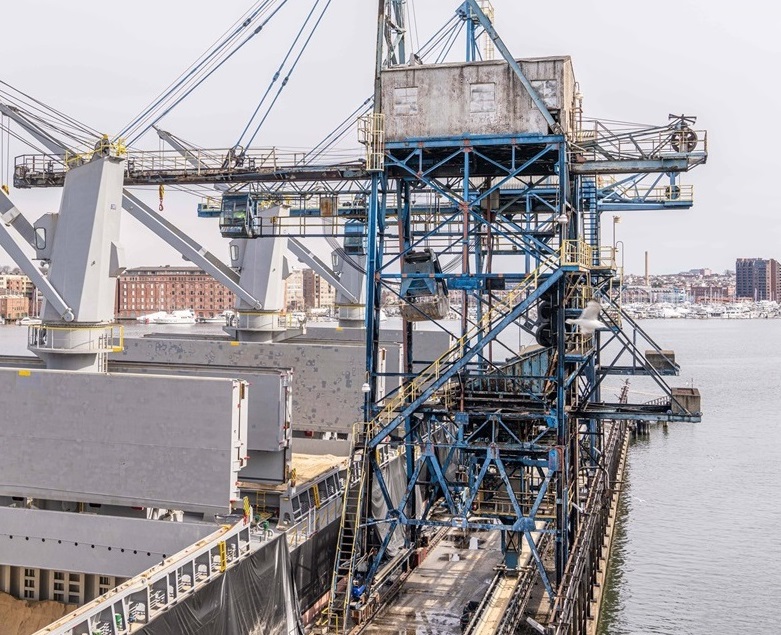

Raw sugar arrives at the refinery in bulk carrier ships from Florida, Africa, and South and Central America. Sugar is lifted from the ships’ holds by clam shell buckets on two gantry cranes, which can off-load raw sugar at the rate of 1 million pounds an hour. The cranes on this pier are operated by Domino personnel. Ship-side work is handled by ILA stevedores.
When the Peninsula Post visited Domino in February, the Panamanian flagged M.V. Century Gold was bringing 33 million pounds of raw sugar from Mexico. It would take about six days to off-load, O’Malley said.
Salt, Cables, and Cruises
Probably the most visible Locust Point import for SoBo residents is salt – mountains of it – rising along the north side of E. Fort Avenue, just before you reach Fort McHenry. Beyond those mountains, you can see the North Locust Point Terminal’s finger piers and accompanying warehouse sheds, operated by the Maryland Port Administration. The salt used on the state’s highways is the largest cargo unloaded here. Paper products, wood pulp, lumber, latex, steel, and other containerized products are also moved through this terminal. These cargoes are unloaded with one container crane and two 75-ton gantry cranes.
At the South Locust Point Terminal, on the south side of Interstate 95, you can see cruise ships that offer vacation getaways. Royal Caribbean and Carnival lines offer year-round cruises, and Norwegian has a fall schedule of cruises. ILA longshoremen handle the luggage and line-handling duties here. The adjacent parking lot has room for over 1,500 cars. Opened in 2006, the cruise terminal’s welcome center is located in a former paper storage shed.

Just east of the cruise terminal is the BalTerm berth and storage facility, which handles autos and paper and forest products. Low-profile general cargo ships operated by the Dutch Spliethoff Shipping Company are frequently seen here, carrying these imported products along with the occasional special cargo, such as yachts.
West of the cruise terminal, where Key Highway ends at East McComas Street, is SubCom, a firm that installs and maintains underwater fiber optic cables around the world. Their ships, docked on the long finger pier, and their crews have been called “the unsung heroes of worldwide communication,” laying and servicing the cables with robotically operated vehicles.
Next time you take a walk out to the Fort, look to the right and the left just before you reach the gate and you’ll see this very active part of our peninsula in a whole new light.
 South Baltimore Peninsula Post
Absolutely fascinating. I have been looking at these areas from the water in my kayak and from Fort Avenue and have wondered for years just what they are unloading. Thank you for solving some of the mysteries. Do these ships leave with any product from Baltimore?
LikeLike