

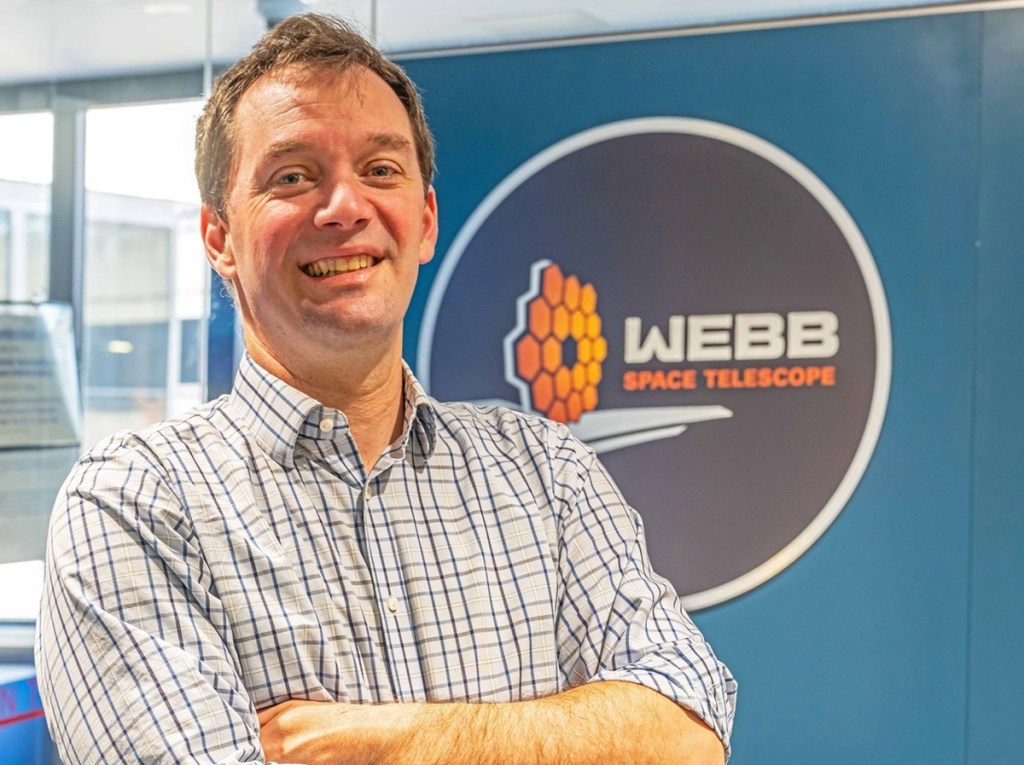
(This story originally appeared in the December 2023 issue of the South Baltimore Peninsula Post newspaper.)
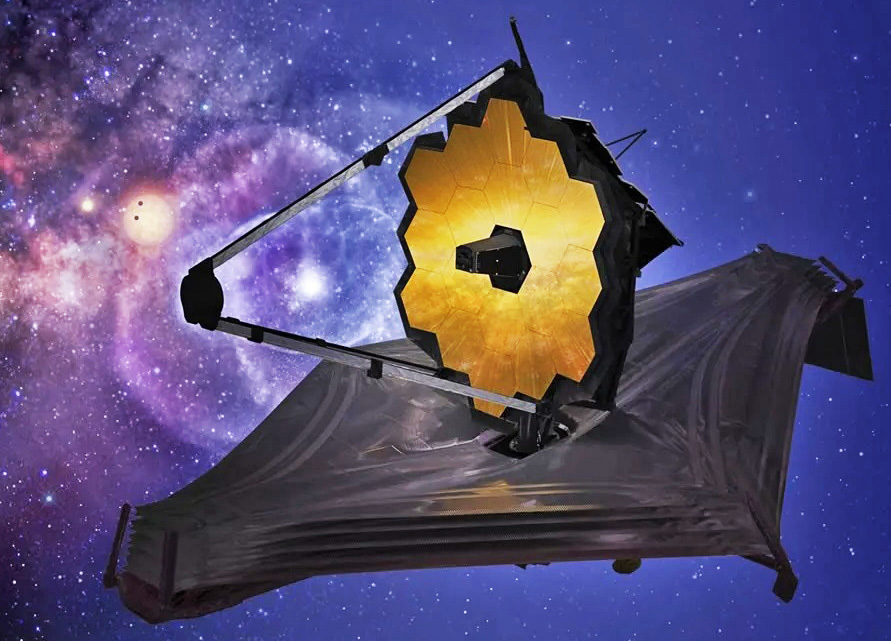
Two years ago, on Christmas Day 2021, Laurent Pueyo was at home in Locust Point with his family when NASA’s James Webb Space Telescope blasted off from South America to begin its exploration of the universe. About a month and a million miles later, the telescope arrived at its target orbit and Laurent helped get it ready to make scientific observations. An associate astronomer at the Space Telescope Science Institute in Baltimore, he spent the next three months working with a team at the Institute on the Johns Hopkins University campus to carefully adjust Webb’s 18 primary mirror segments to bring the telescope into focus. The amazing new views of our universe have continued ever since.
The Princeton-trained scientist originally from Toulouse, France, moved to Baltimore in 2010 to work on Webb and eventually settled on the peninsula, near Riverside Park, with his wife Natalie in 2013. The couple and their three children now call Locust Point home. I talked with Pueyo in November about his astronomical career as well as his scientific research exploring “extrasolar planets” (planets around stars other than our Sun) and a new space telescope project he is working on that will search for Earth-size planets that have the chemical building blocks of life. – Steve Cole
How did you discover SoBo, and what drew you to living here?
It was really the proximity to water. My wife is a rower, and she rows [from Middle Branch Park] in Cherry Hill. When we first moved to Baltimore, we lived in Roland Park. I would drive her down to the boathouse early in the morning and I’d go to a coffee shop here and work. The area was alive that early in the morning: people were out, people were running. It felt like a really nice neighborhood. So, when it was time for us to buy a house, we decided on South Baltimore. And then we discovered there are a lot of restaurants and activities that we didn’t know about. We absolutely love it here.
How did you get interested in astronomy and space telescopes?
I was good at science in high school back in France. It took me some time to find out what I loved to do. I did applied physics, electrical engineering, and some software work. At Princeton, I worked on astronomical instrumentation, building cameras for telescopes. After a month, I knew this is what I’m going to do for the rest of my life. It was the combination of a hard technical problem and the things you can look at with these instruments – the universe! I was fascinated.
What type of work did you do on Webb as it was getting ready for launch?
I was good at optics, so I was hired for the alignment of the telescope. Webb has a few coronographs, which is kind of my niche in instrumentation. These instruments block the light from a star so you can look for planets orbiting a star, which is my area of research. They are very finicky to operate. I ended up doing a lot of the operations for those instruments, helping prepare the software, understanding how you analyze the data.
How much is known about planets around other stars?
Thirty years ago, we had not seen any extrasolar planets, but some scientists theorized they could exist. That changed in 1995 with the first discovery using mainly ground-based telescopes. Fifteen years ago, we had found a few hundred of them, mainly giant planets the size of Jupiter. The Kepler space telescope, launched in 2009 to systematically look at a few hundred thousand stars, brought us up to a few thousand planets, and surprisingly a lot of small ones. It established that “super Earths,” planets two to four times the size of our Earth, are the most common type of planet. It’s much harder to detect small, Earth-size planets, especially ones that orbit in what we call the “habitable zone.” And now we’re beginning to explore the atmospheres of these exoplanets, starting with the giant planets. With data from the Hubble Space Telescope, we started to do a little of this work. You could detect water vapor but not much else.
How will Webb advance what we know about extrasolar planets?
Webb is much bigger than Hubble, so it can gather more photons of light and it can collect light from the infrared part of the spectrum where you can see more types of molecules. So far with Webb, we’ve seen carbon dioxide, methane, carbon monoxide, and more on a few giant planets, and that’s just the tip of the iceberg. This lets you understand the chemistry and atmospheric processes of these giant planets and compare them to what we know about giant planets in our own solar system. There’s so much more cool stuff that will be coming out next year from data we already have.
A big unsolved question is how do the giant planets form. We have a really good picture of how we thought they formed using just the ones in our solar system. But now we find giant planets around other stars that complete an orbit in 10 days, others that take 100 years. They’re all over the place. Why? There’s no big, unified theory that explains it all. It’s a big puzzle, and these data will help us solve it.
And what about finding Earth-like planets that could support life?
That’s much harder, but it’s one of the things I’m working on now at the Institute. I’m part of a team that’s preparing the Habitable Worlds Observatory, which is a future NASA flagship space telescope. With Webb, we can see giant planets and we should be able to eventually study the atmospheres of the super-Earths, but not Earth-like planets. This mission will both search for them and analyze their chemistry. It’s a big part of my job right now. We have a lab here doing custom optics to find Earth-like planets around other stars. I’m also working on committees of scientists to define this mission and to build consensus across the community on what it’s going to look like. The mission just had its first science meeting this month.
A decade or two from now, what do you expect we’ll know about other habitable planets in the universe?
First, we’ll know which stars have habitable planets. And we’ll know if the building blocks of life are there, so we’ll know how common or rare these conditions are in the universe. What’s next after that? We could focus a giant telescope on one specific planet and try to look for continents. I’ll probably be retired when that happens, but it will certainly inspire more questions.
 South Baltimore Peninsula Post