


(This article originally appeared in the August 2023 issue of the South Baltimore Peninsula Post.)
COVID had a dramatic impact on the paintings created by local artist and SoBo restaurateur Sami Tabet. Before the pandemic, Sami focused on painting figures and landscapes, many inspired by his native country Lebanon. These paintings hang in his restaurant, Byblos Lebanese Cuisine (1033 Light Street).
Now, face masks – the ubiquitous emblem of the pandemic – have come to dominate his art.
During COVID, when face masks became a common sight, Sami started to use them as a symbol in his paintings. To him, masks capture the face of the person who wears it.
Sami explains, “People look at a mask from the outside. I look at it from the inside. Masks give you the impression of your face, or anybody’s face, if you look at the mask itself, after you wear it.”
In many of his paintings of masks, the cloth contours in a way that resembles the human face. In some paintings, he has even given them eyes. There are paintings that feature masks as subjects of a portrait, while others portray them dangling in a storm drain or in the mouth of a bird.

Sami has found painting and sketching masks to be therapeutic, he says, for himself and for people who have connected with and purchased these works. “It is encouraging to know that your products – or your inner feelings – especially about these masks, can help provide direction to somebody interested in your art,” he says.
Even though the national COVID emergency has officially ended, Sami still plans to incorporate masks into his art, as he feels the pandemic will “keep going.” Masks may come and go from being the main focus of his art, he says, but they will remain in the foreground and background of his work. “Whether you agree or disagree or you wear masks or you don’t wear them, they are there,” he says.
Making art has been an important part of his life since his childhood, Sami recalls. It’s something he tries to build his life around: “Anything to do with art is mine.”
Sami immigrated to the United States from Lebanon when he was 28. When he first arrived in the United States, he lived in Ohio. After living there for a few months, he moved to Baltimore, as he wanted to live in a more urban area and he had a cousin living here. Soon after moving to Baltimore, he started taking continuing education classes at the Maryland Institute College of Art, most of which were evening classes.
To help him get by while at MICA, Sami put his artistic talents to commercial use. He created advertisements for an outdoor billboard company. In 1993, he graduated from MICA with a bachelor’s degree in General Fine Art and, that same year, became a U.S. citizen.
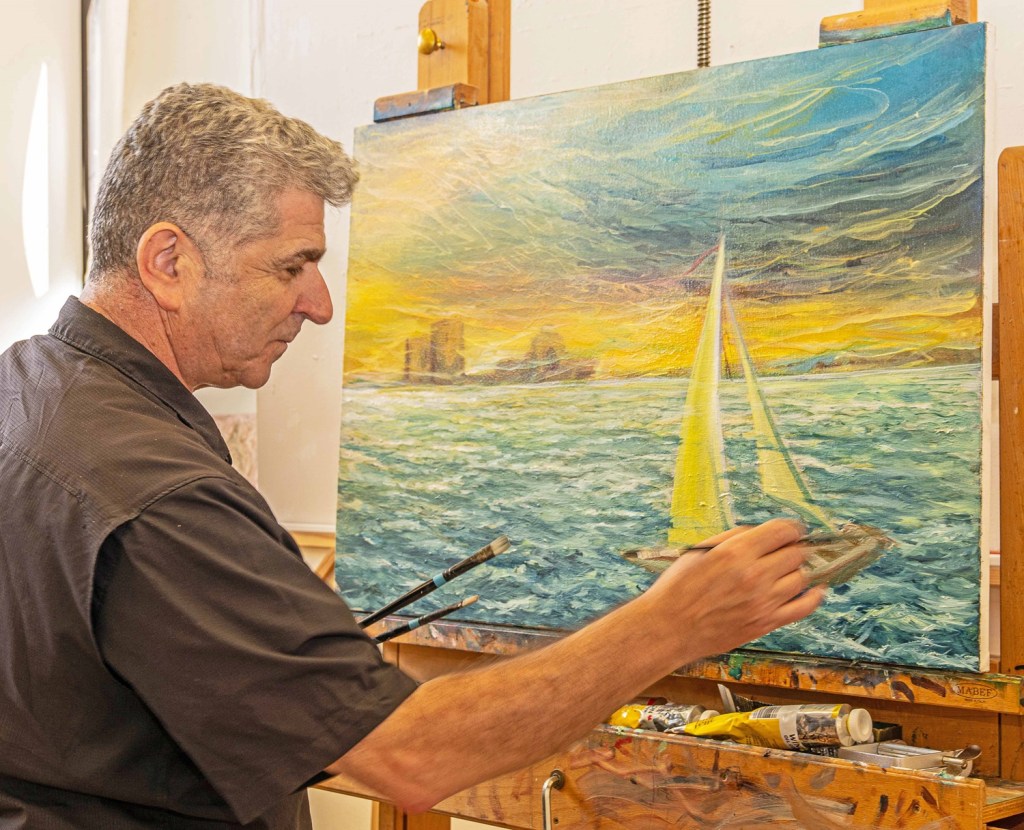
For the past year, Sami has been painting from his studio in the School 33 Art Center (1427 Light Street). Before then, he painted in his basement and, for a while, above his restaurant on the second floor of the building. During the pandemic, when customers could not come inside the restaurant, Sami used that space. He painted most of his pandemic paintings there. He then decided to rent the studio at School 33 to have more space.
Before masks became a prominent symbol in his art, one of the things Sami included in some of his paintings, especially those that were more personal, was Arabic lettering. He would use it to mix and blend the paint.
When he used this technique in portraits, he would blend the lettering into the background of the piece. This technique can also be seen in some of the pandemic paintings.
When asked what the lettering in the paintings says, Sami explains that there is no meaning behind the words. The words he uses are the words that come into his mind at that moment.
Throughout Sami’s work, Lebanon, his home country, keeps coming back as a theme. “I came here not too young, honestly, to forget about the past,” he said. “You need to look to the past. We still have old friends. We still have the old country. We still have a house back there. Those things are going to pop up at some point.”
Sami and his wife Hala opened Byblos in 2010. At first, they bought the building as an investment, hoping to rent it out to other businesses. But, after multiple businesses were unsuccessful, they decided to open one themselves.
Hala handles the cooking, as Sami says he does not cook. He instead serves as a waiter and manager. He also focuses on creating the atmosphere of the restaurant with his paintings that cover the walls. He views Byblos as his own gallery, rotating his work every now and then.
Although Sami is not a resident of South Baltimore, he spends most of his days here and feels like a part of the community. Most mornings, he is in his School 33 studio, and the afternoons and evenings are spent in the restaurant. Though he knows that retirement is in his future, he has not mapped out what comes next for his art or his business.
“I never plan anything because what you have planned, God has different plans for you the next morning,” says Sami. “So, you got to be ready.”
You can view Sami’s collection of pandemic paintings and contact him for commissions on his website. – A. W. Taylor
 South Baltimore Peninsula Post